The new cultural centre, built on the site of the old race course in Athens, opened a few weeks ago. We went to the opening of their first exhibition which featured paintings by Yannis Moralis and sculpture by Christos Kapralos (posts to follow).
Designed by Renzo Piano, the cultural complex which sits in the middle of a 20-hectare site, most of which has been turned into a park, will house the national library, the state opera, and includes exhibition centres and various cafes and restaurants. At one end of the building is the park that rises on an artificial hill reaching the roof of the building, and at the other end, the sea, separated from the building by a busy dual carriageway. The two 30-metre high glass buildings that will house the opera house and library face each other across a huge stone square, an 'agora', a reference to the central gathering spaces in ancient Greek cities, and beyond is a 400-metre long reflecting pool, a canal. Two monumental staircases rise up to the rooftop on either side of the glass buildings. A spectacular terrace on the summit provides views of the Mediterranean to the south while the rooftops of the city and views of the Acropolis and the Lycabettus hill are to be seen on the north side.
We did not have much time to explore the building which we intend to do when we next visit Athens. Our primary aim was the exhibition, but half an hour of exploring were enough to give us a taste of the building and the surrounding areas. I have no photographs of what the building and park as a whole look like, as there was no time to walk across the other side of the pool/canal.

We left the car park and entered this open space, dominated by the ancient olive tree.

The reception area unites the two glass buildings

and leads to the agora.


with the staircase that rises up to the rooftop, this one with views of the sea.

The viewing gallery provides excellent views of the canal.

Steps across the canal can be used as seating for the spectators of the sailing boat races that take place here every weekend.

It was dusk and the bridge over the dual carriageway had turned a golden red

while the reflections on the water were exquisite

We walked along the promenade on the edge of the canal,

enjoyed the music played by these three musicians

and reached the end of the pool where three small sailing boats were moored.

We turned left and entered the park

groves of cypresses, pomegranate and olive trees, lemon and fig

while the scent of lavender was all around us.


Lots of grasses too.
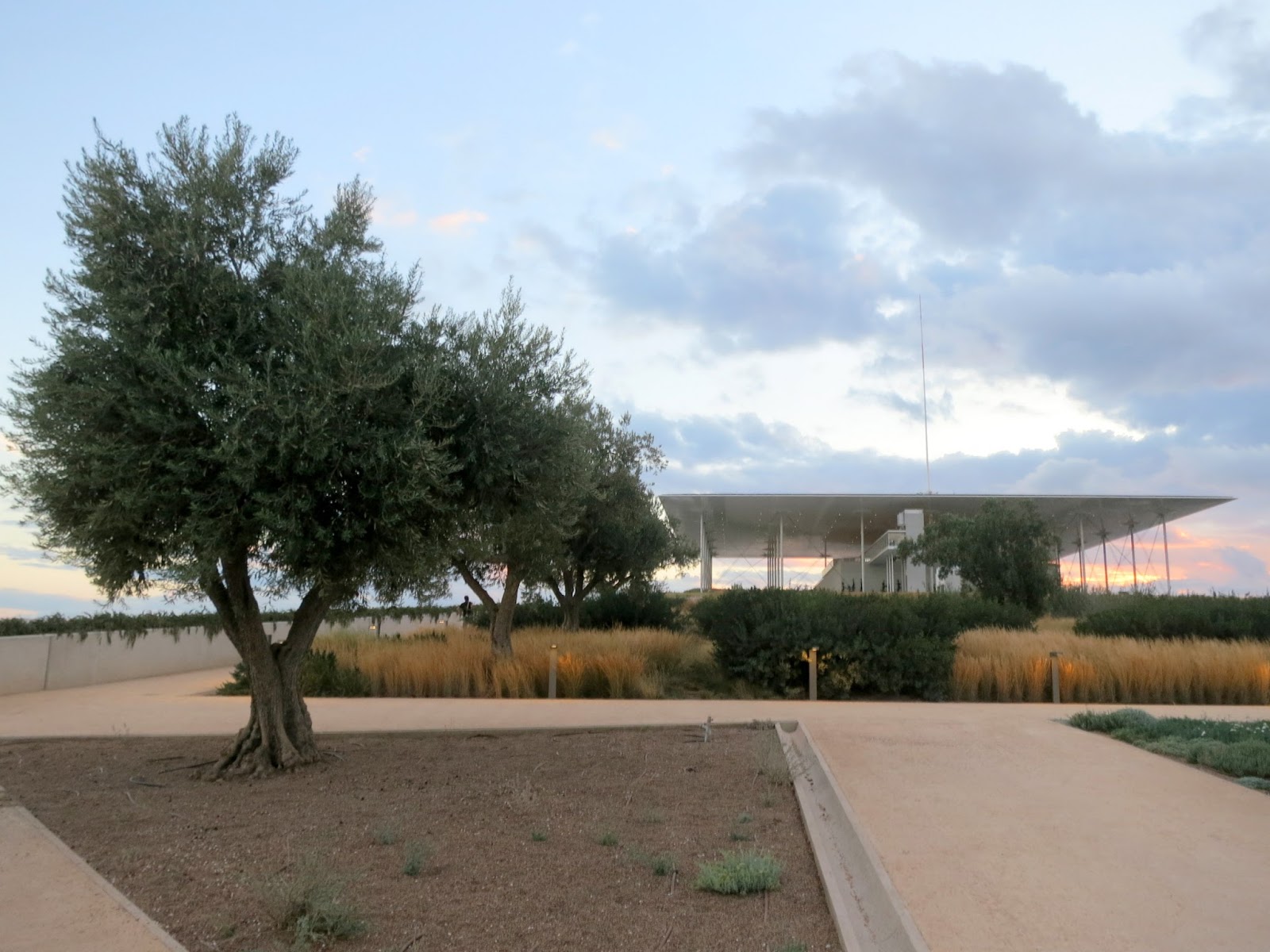
The park is situated on a huge artificial hill that rises towards the south end of the site, creating a view of the sea. 'From our first observations there emerged the idea that by raising the ground - with a slight slope and a progressive course - we could restore the beautiful view of Kallithea. In that way, without realising it, visitors strolling through the park would find themselves at a height of 30 metres', wrote Renzo about the project.
As we walked through the park up that very gentle slope, we could see the roof of the two glass buildings, paper-thin concrete held aloft by slender columns, dubbed 'the flying carpet' by Piano.

Having reached the top we could see the canal

Another paved slope led us to

the spectacular terrace at the summit which feels like being on the deck of a yacht, floating above the city.

The terrace is beneath the shade-giving 'flying carpet'.

We could see the park from here and how it extends on to the roof of the opera house and library.

Views of Athens and the Lycabettus hill in the distance

The wafer-thin roof is held in place by a gossamer grid of columns and wiry rigging, crowned with a central mast. The structure has more in common with boats and sails: 'What I really do in life is sailing', says Piano. 'The ingredients are the same in architecture: light and air and breeze'.

We walked all around


Piraeus

the park

and it really did feel like you were on a sailing boat.

The views were equally spectacular at night

and after the reception

we came across the limousines waiting for the President of Greece who had been at the opening.


