'Shuffle the cards. Masculine? Feminine? It depends on the situation. Neuter is the only gender that always suits me'.

Claude Cahun and Gillian Wearing, Behind the Mask, Another Mask, at the National Portrait Gallery, London.
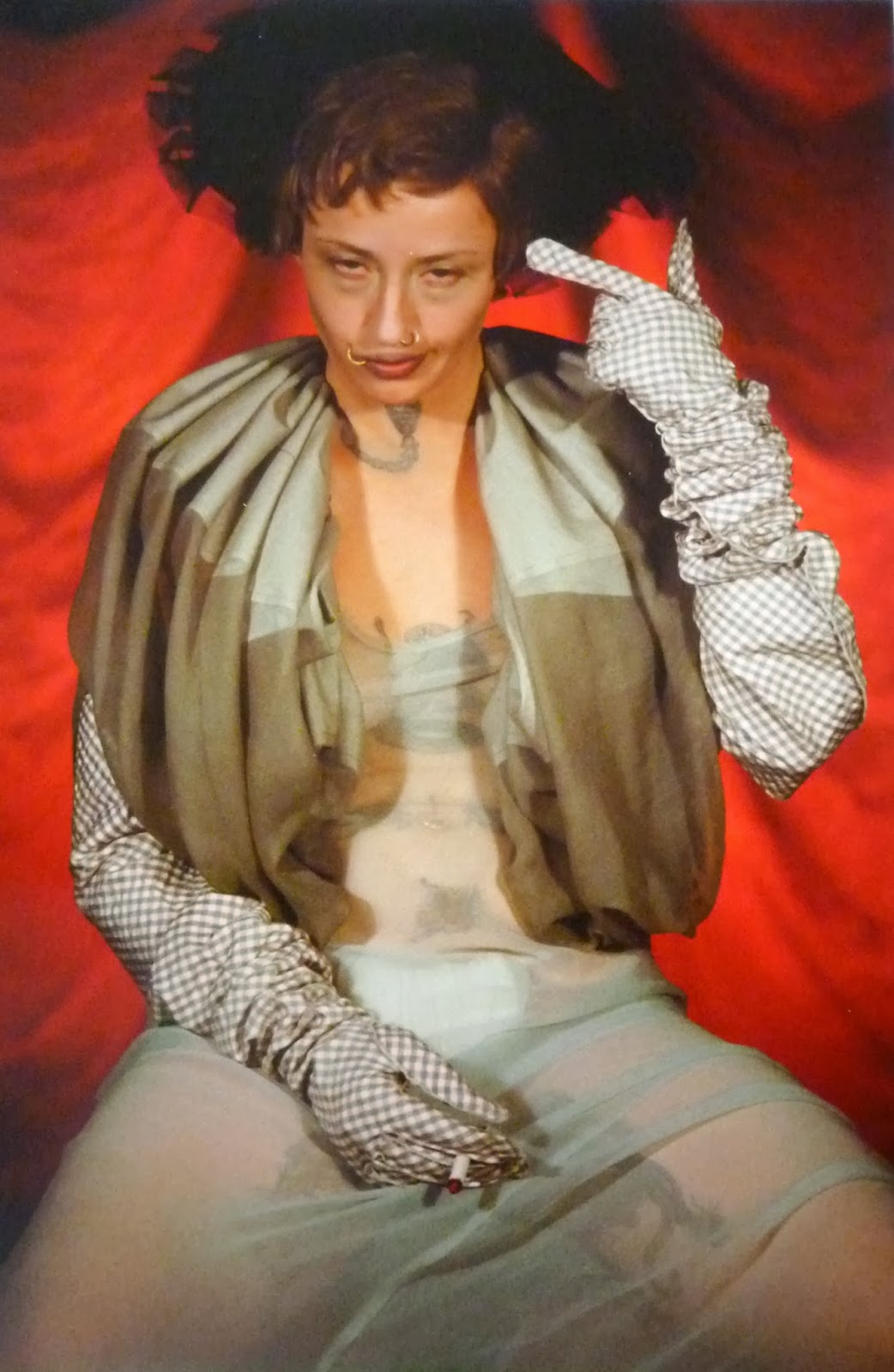
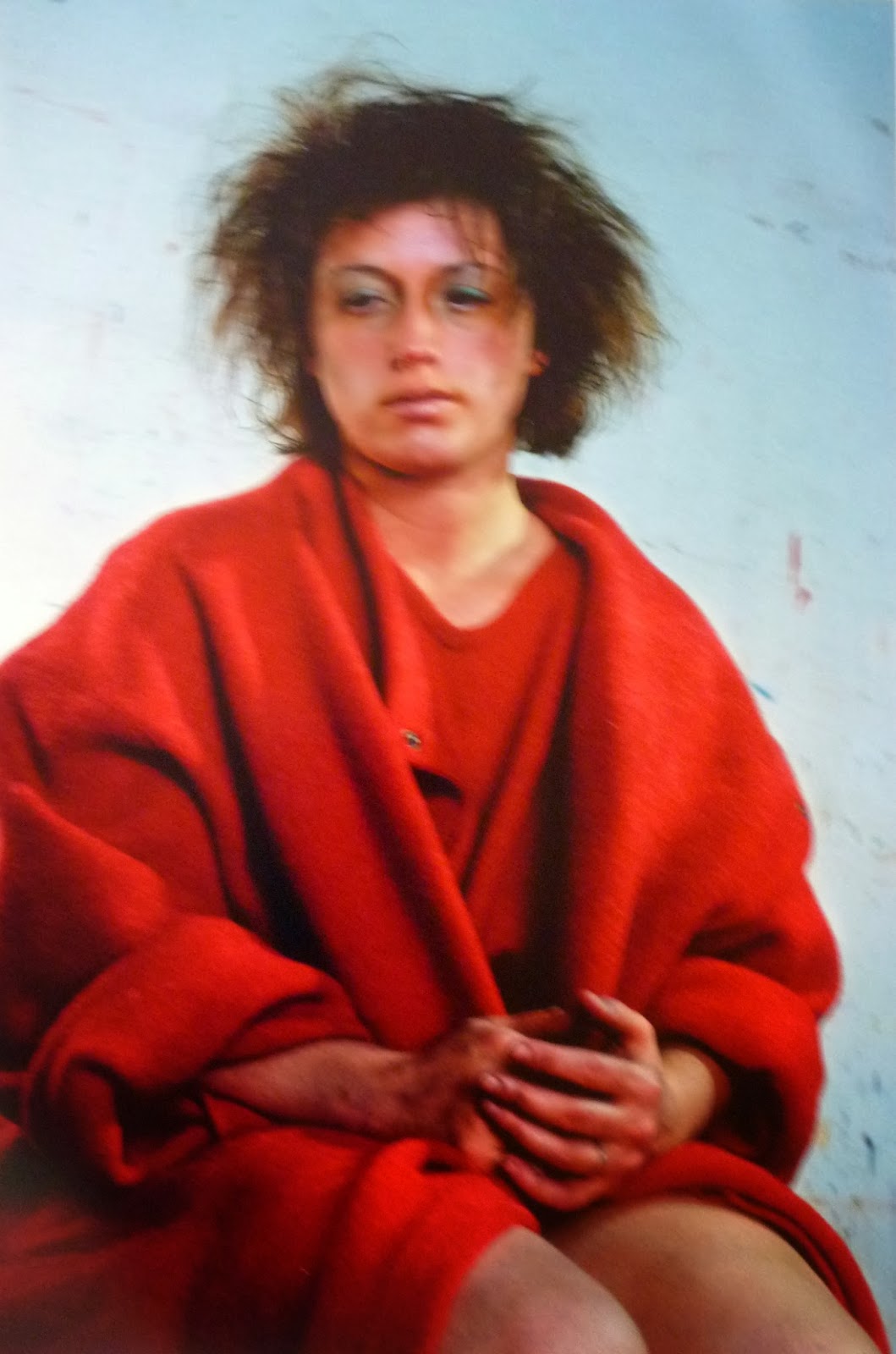
This exhibition draws parallels between the two artists. Both of them share a fascination with the self-portrait and use the self-image through the medium of photography to explore themes around identity and gender, which is often played out through masquerade and performance.
Even though I am great fan of Gillian Wearing's work, my real interest lay with Claude Cahun when I went to see this exhibition. Consequently, this post is about Cahun's work. Most of Wearing's work that was shown in this exhibition I saw at Whitechapel Gallery in 2012 and you can see it here .
Naming and identity was so central to Cahun's life, that writing this post has caused me problems. Our language has not yet evolved to speak outside binary gender. Personal pronouns are intended to define, yet I did not have the language to refer to Cahun. Some transgender people use the pronoun 'they' to refer to themselves, but I found this really difficult, so I am using the female pronoun in square brackets.
Claude Cahun was named Lucy Schwob when [she] was born into a Jewish intellectual family in Nantes, Western France, in 1894. At school [she] fell in love with Suzanne Malherbe, who became [her] life-long partner. The couple moved to Paris in the early 1920, where they adopted the gender neutral names Claude Cahum and Marcel Moore. While there, Cahun studied literature and philosophy at the Sorbonne and they both became involved in the Surrealist movement and increasingly with politics.
Cahun challenged gender roles in a society where they were rigidly enforced. A biologically born woman, [she] portrayed and embodied the tropes of conventional masculinity. [She] shook the foundations and helped sow the seed for challenging the binaries of gender. [She] championed the idea of gender fluidity, describing [herself] as 'neuter', putting [herself] outside the usual categories of gender. In [her] autobiography, Disavowals, [she] wrote: 'Shuffle the cards. Masculine? Feminine? It depends on the situation. Neuter is the only gender that always suits me'. [Her] adoption of a sexually ambiguous name, and [her] androgynous self-portraits display a revolutionary way of thinking and creating.
Furthermore, [her] participation in the Parisian Surrealist movement diversified the group's artwork and ushered in new representations. Where most Surrealist artists were men, and their primary images were of women as isolated symbols of eroticism, Cahum epitomised the multiple possibilities of genders and of the body.

'Under this mask, another mask', wrote Cahun. In this [she] pre-empted the current feminist philosophers' work, and in particular, the work of Judith Butler, (1990), who sees gender as performance. Butler sets out to criticise our outdated perceptions of gender, which is limiting in that they adhere to the dominant societal constraints that label gender as binary. 'Gender probes to be performance - that is, constituting the identity it is purported to be. In this sense, gender is always a doing, though not a doing by a subject who might be said to pre-exist the deed', writes Butler. She continues: 'when we say that gender is performed, we usually mean that we've taken on a role; we're acting in some way.... To say that gender is performative is a little different... For something to be performative means that it produces a series of effects. We act and walk and speak and talk that consolidate an impression of being a man or being a woman... we act as if that being of a man or that being of a woman is actually an internal reality or simply something that is true about us. Actually, it is a phenomenon that is being produced all the time and reproduced all the time'.
Thus, Butler perceives gender as being constructed through a set of acts that are said to be in compliance with dominant societal norms. This performance is ongoing and out of an individual's control. In fact, rather than an individual producing the performance, the opposite is true. The performance is instead what produces the individual. Gender performativity is realised throughout many aspects of our lives, specifically in our infancy and young childhood, our teen years, and finally our adult lives. The socially constructed aspect of gender performativity is perhaps most obvious in drag performance, which offers a rudimentary understanding of gender binaries.

The mask Chakrabarti holds was prompted by the comment to the artist that her public persona is mask-like, often interpreted as 'grim', 'worthy', and 'strident'.
Early Self-Portraits:
In this section of the exhibition we see Cahun's transition from young woman, to young boy, to [her] fully formed, gender-neutral self, as [she] described it.

silver gelatin print, 1914
In this early self-portrait the artist's head, with her wild, Medusa-like hair spread out across the pillow, appears disembodied, as though floating above the sheets. It is possible that this image, in which she looks like an invalid in a hospital bed, refers to her earlier periods of ill health and anorexia. In common with much of her work, the likelihood is that although the concept was Cahun's, the photograph was taken by her partner, Marcel Moore.

silver gelatin print, 1913

Self-portrait (seated on granite rocks), (sepia toned silver gelatin print, 1915)


Self-portrait (shaved head, material draped across body), 1920, (modern silver gelatin print from original negative of 1920)
In this strikingly contemporary image Cahum stands against a dark backdrop.

Self-portrait with shaved head, looking over left shoulder, (copy print, silver gelatin print after an original silver gelatin print of 1920)

Self-portrait (reflected image in mirror with chequered jacket), silver gelatin print, 1928
Cahun plays on the notion of duality and Narcissus in this image. With golden hair and bronzed skin, [she] looks over [her] shoulder at the viewer, [her] reflection looking away from the mirror.
Surrealism:
When Cahun and Moore moved to Paris they were immersed in the culture of the city and befriended the founding Surrealist, Andre Breton. They became increasingly involved in politics, and later protested against the spread of Fascism in Europe.
Cahun's surrealist activity took many different forms, including writing and object-based work. Whereas the majority of Surrealists were men, in whose images women often appear as eroticised objects, Cahun's self-portraits explore female identity as a multifaceted construct.


Double Exposure in a Rock Pool, 1928, (silver gelatin print)

Naked Reclining on Sand with Coiled Seaweed, 1930, (silver gelatin print)

Je Tends les Bras (I extend my arms), 1932, (modern silver gelatin print from an original negative)

Studies for a Keepsake, 1925, (four silver gelatin prints mounted on card)
Cahun's disembodied head floats in different poses like a specimen, enclosed within a glass bell jar. At the time [she] made this work, Cahun was concentrating on creating assemblages of objects and photographing them in the Surrealist tradition. In this work [she] objectifies [herself]; with painted lips an shoulder-length hair, [she] appears trapped by [her] female identity.
Performance:
In 1937, to escape the spread of Nazism in Europe, Cahun and Moore left France and moved to a house in St Brelade's Bay, Jersey, an island where they had spent childhood holidays. Cahun continued to make surreal, staged self-portraits, which were less androgynous and more feminine. [She] also created a series of intriguing and playful performative works in pastoral settings.

With Round Frame, 1938 (silver gelatin print)
Photographed against a doorway, and dressed in a housecoat, Cahun holds a circular frame around her face, as though [she] is appearing in a conventional painted portrait.

In Cloak with Cloaked Figure, 1939, (silver gelatin print)
In this group of works, Cahun plays with portrait conventions and stereotypes, using the architecture of La Rocquaise as a backdrop. With a nod to [her] Surrealist past, [she] appears as a cloaked figure in a double portrait next to a mannequin twin version of [herself].
Memento Mori:
After [her] release from prison Cahun suffered from ill health and yet [her] late works show [her] boldly confronting death. Cahun poses in diaphanous clothing, reminiscent of an angel, with the churchyard, where [she] would be buried, as the backdrop. Cahun died in 1954 at St. Helier hospital, Jersey.


Marcel Moore and Claude Cahun, 1950, (silver gelatin print).
This late image of the couple shows them in bathing suits, posing either side of an archway in the garden of La Rocquaise. Hauntingly, Cahun's face and torso have been defaced; a possible portent of her death four years later.