Showing posts with label portraiture. Show all posts

Saturday, 18 October 2025

Lucien Freud at the Thyssen-Bornemisza Museum


Lucien Freud at the Thyssen-Bornemisza Museum, Madrid.

Like most of the photos I took in this museum, not a very good quality of photographs again,  but I just have to live with it, as I don't know when I will be able to go to Madrid again.


I am including two photos of this painting here. This first one is taken from the internet but in my experience these get deleted after a while, so I have also included the photo I took which is unfortunately very hazy.


Reflection with Two Children (Self-Portrait), 1965

This painting combines an intense close-up of the artist, who twists his body in order to study his own reflection in a mirror at his feet on the floor, with the lamp positioned behind him, which he renders as a semi-abstract form that hovers over the painter. As John Russel states, the viewer is unable to grasp the image at first glance, as it is one of the first self-portraits in which Freud experiments with a set of two mirrors, and, as Catherine Lampert notes, we are forced to run our eyes up the figure, coming face-to-face with the artist's gaze. The idea of a mirror reflection is reinforced by the plain grey background that causes the touches of light concentrated on the face and hands to stand out even more powerfully.

The image of Rose and Ali, his children, is inspired by the tomb of the dwarf Seneb and his Family in the Cairo museum.


Seneb and his Family. You can read about this sculpture here


Large Interior, Paddington, 1968-69 (oil on canvas)

Freud's daughter Ib, wearing an expression of infinite sadness, lies semi-naked on the floor by a huge plant placed opposite a window. Freud here employs a cinematographic angle and upward perspective to depict the scene. The scene is captured from a bird's eye view. The houseplant with twisted branches is given particular prominence.

The semi-naked body of the girl on the floor is unnaturally twisted: the shoulders are parallel to the floor, while the hips and bent knees are turned partly to one side.

Freud's interest in portraying the solitude of human existence through the human body, in portraying alienated, tormented humankind, is evident here. Jean Clair noted that 'with the exception  of Picasso and Bacon, never before had the reality of the body been so harshly and so lovingly described, through the perverse means of distortion, in its beauty and its ugliness, in its stsrength and in its vulnerability, in its attraction and its repulsion, in its ceaseless and bitter search for individuality, expressed in a style which can be compared to the great styles of the past'.


Portrait of Baron H.H. Thyssen-Bornemisza, 1981-82

Portrait of the founder of the museum. The two men had a close rapport and long artistic relationship.


Man in a Chair (Portrait of Baron H.H. Thyssen-Bornemisza), 1985 (oil on canvas)


Tuesday, 25 February 2025

Portraits


Portraits at the Minicipal Gallery, Alimos.

The portraits in this exhibition are from the private art collection of Sotiris Felios who has been collecting since the 1980s. Felios collects works of Greek artists who live and work in Greece. The collection comprises more than a 1000 works of art.


Tassos Misouras, Waiter at a Cafe in Omonia, Early 20th Century, 1996, (oil on cardboard)


Kostas Papatriantafyllopoulos, Portrait of the Poet, Nikos Kavadias As a Young Man, 2005, (oil on canvas)


Maria Filopouloou, Self-Portrait, 1986, (tempera on cardboard)


Alekos Fassianos, Swimmer, (oil and gold paint on canvas)


Yannis Tsarouchis, Woman from Megara and Cupids, (tempera on paper)


Leda Contogiannopoulou, Self-Portrait, 2007, (oil on cardboard)


Christos Bokoros, Myrsini, 2008, (oil on linen)


Louiza Missiou, Flesh on Black Background, 2009, (oil on cardboard)


Giorgos Rorris, Androniki, 2013, (oil on canvas)


Thanassis Makris, Leda, 2009, (oil on canvas)


Edouard Sacaillan, Peasant, 19900, (oil on canvas)


Alecos Levidis, Models in the Studio, 2010-2013, (mixed media on canvas)


Looking at the images at the bottom of the painting


detail from the main image


Sandra Christou, 15 Portraits - Grid of Zeus 1, 1996-2006, (oil on canvas)


Achilleas Papacostas, Untitled, 2004, (oil on canvas)


Antonis Staveris, David's Room, 2022, (acrylic on canvas)


Vassilis Papanikolaou, Portrait of Julia, 2005, (egg tempera on wood)


Kostas Papanikolaou, Vanda, 1985, (oil on canvas)


Dimitris Tataris, Self-Portrait, 2010, (pencil, ink on paper)


Tasos Aridas, The Afternoon Coffee Break, 2006, (oil on canvas)


Gerasimos Kotsolakos, Portrait with Intense Eyes, 2018, (oil on canvas)


Ioanna Kafida, Miles, 2010, (oil on canvas)


Konstantinos Papamichalopoulos, Self-Portrait, 2004, (oil on canvas)


Emmanouil Bitsakis, Solace, 2017, (acrylic on canvas)


Sunday, 26 May 2024

Portraits at the National Portrait Gallery


We visited the National Portrait Gallery to see two temporary exhibitions but while we were there we also had a look at some of the permanent exhibits, some of which we had seen before. Most of the portraits (but not all) in this post are from the 'Reframing Women and Self-portraiture' section of the permanent collection 'where by choosing to represent themselves looking out at us, women have countered the idea of a passive feminine sensibility. Often their self-portraits disrupt past and contemporary representations of women made by male artists for the pleasure of other men'.


Laura Knight with model Ella Louise Naper, 1886-1972, Self Portrait. 

Laura Knight was a pioneering figure in British art. This self-portrait is a bold statement of her ambition at a time when men dominated the art world. Knight is shown painting a nude model at a time when women were not allowed to paint nudes. Knight also worked as a war artist, notably documenting the Nuremberg Trials in 1946. 


Vanessa Bell, 1879-1961, by Duncan Grant. 

Vanessa Bell was a pivotal member of the Bloomsbury Group. Bell embodies the Bloomsbury Group's progressive attitudes toward art, sexuality and relationships. 


Virginia Woolf, 1882-1941, by Vanessa Bell. 

This portrait of Virginia Woolf, was painted by her older sister, Vanessa Bell, who shows Woolf knitting in an armchair. The blurred eyes suggest the importance of her inner creativity.


Eileen Agar, Self-Portrait, 1899-1991


Barbara Hepworth, Self-Portrait, 1903-75,  (oil and pencil on board)


A self-portrait of one of Britain's foremost abstract sculptors, holding a sketch-board


Amy Grantham, City Portal, b. 1978,  (gelatin silver print)

A self-portrait of Grantham and New York, where it was taken 


Ajalvportratt, Akersberga, Everlyn Nicodemus, b. 1954,  (oil on canvas, 1982)

Through the layering of multiple faces, Nicodemus contemplates herself from multiple perspectives


Reaching Heights and Aphrodisiacs Being Social Constructed, by Chifa Kumari Singh Burman, b. 1957 (etching and aquatint, 1988)

Notions of selfhood are dismantled to reveal a determined artist and a young woman ready to escape the social constructions of womanhood.


Paul Venelay, 1892-1984, Self-Portrait, (oil on canvas, 1927)

Subtitled Harmony Vezelay's self-portrait blends the artist's abstract style with a figurative representation.


Issy Wood, Self-portraits, b. 1993, (oil on linen, 2021)

Wood points to the absurdity of life, while also shining a light on the artifice of image-making.


Human Toilet Revisited, Sarah Lucas, b. 1962, (inkjet print, 1998)

Lucas' provocative self-portraits challenge the cliched image of the modern artist at work.


Smoking, Sarah Lucas, b. 1962, (inkjet print, 1998)

By adopting an androgynous appearance, Lucas defies stereotypical representations of gender and questions of female objectification.


Gluck, 1895-1978, (oil on canvas, 1942)

Gender non-conforming painter Bluck adopts here a confident posture as a marker of strong pesonality.


Paula Rego, 1935-2022, Self-portrait, (pastel on canvas, 1994)

In this self-portrait, Rego shifts the focus onto herself by evidencing her artistic skill and the connection this has with allegorical representations of painting.


Germaine Greer, b. 1939,  by Paula Rego

Australian-born writer, broadcaster and critic, Greer came to the UK in 1964 to study at Cambridge University. Her book The Female Eunuch (1970), was one of the defining feminist texts of the period. Her radical views have attracted controversy throughout her career. 


The Moor, Salman Rushdie, b. 1947, by Bhupen Khakhar

This portrait celebrates the decades-long friendship between Rushdie and Khakhar. Indian-born Rushdie came to the UK as a teenager. Much of his work is set in the Indian sub-continent and combines magical realism and historical fiction. His second novel, Midnight's Children won the Booker Prize.

In 1989, Ayatollah Khomeini, leader of Iran, issued a fatwa condemning Rushdie to death for allegedly committing blasphemy with his novel The Satanic Verses. Rushdie lived in hiding for many years and narrowly survived a violent attack on stage in the US in 2022.  In this portrait Khakhar has surrounded his sitter with scenes from Rushdie's novel The Moor's Last Sigh, a semi-autobiographical text in which Khakhar appears as an accountant, his first career.


Self-portrait with Charlie, by David Hockney, b. 1937

Hockney is fascinated with the observation and depiction of relationships. He painted this large-scale portrait of himself and his close friend, Charlie Schelps, from his light-filled studio in the Hollywood Hills. Completed in just a few sittings, Hockney worked directly onto the canvas in oils, without photographic reference or preparatory drawings. The painting sets up a triangular exchange of gazes between viewer, artist and model. Hockney says: 'I am constantly preoccupied with how to remove distance so that we can all come closer together, so that we can all begin to sense we are the same, we are one'.


Sadie, Zadie Smith, b. 1975, by Toyin Ojih Odutola

Zadie Smith became a prize-winning author at the age of 25 for her first novel White Teeth. Smith has described Toyin Ojih Odutola as the 'central light in a thrilling new generation of black artists'. The map of north-west London connects the writer to where she grew up, while the shadow of a palm tree alludes to her mother's homeland of Jamaica. Ojih Odyutola gave the portrait Smith's original name, which she changed at 14 to make herself sound more interesting.

For Smith, the strong and self-assured pose chosen bhy Ojih Odutola is significant: 'this equality of gaze between subject and artist is not something I remember ever really seeing in any portrait of a woman, never mind any portrait of a black woman... it's an artist looking at a writer looking back'.


Self-portrait with Esme, by Chantal Joffe, b. 1969

The self-portrait is central to Joffe's practice. It is a way for her to consider time passing, something she feels acutely watching her daughter, Esme, grow up. The mother and daughter relationship is a recurring theme in Joffe's work. Approaching middle age and bearing her caesarean scar, the artist stands side by side with Esme, both of them unselfconscious in their nakedness. She says:'when I am painting me I feel exquisite, so beautiful - but that's what I feel about all my sitters'. Although Joffe's painting is expansive and gestural, every mark, which may appear casual, is carefully considered.


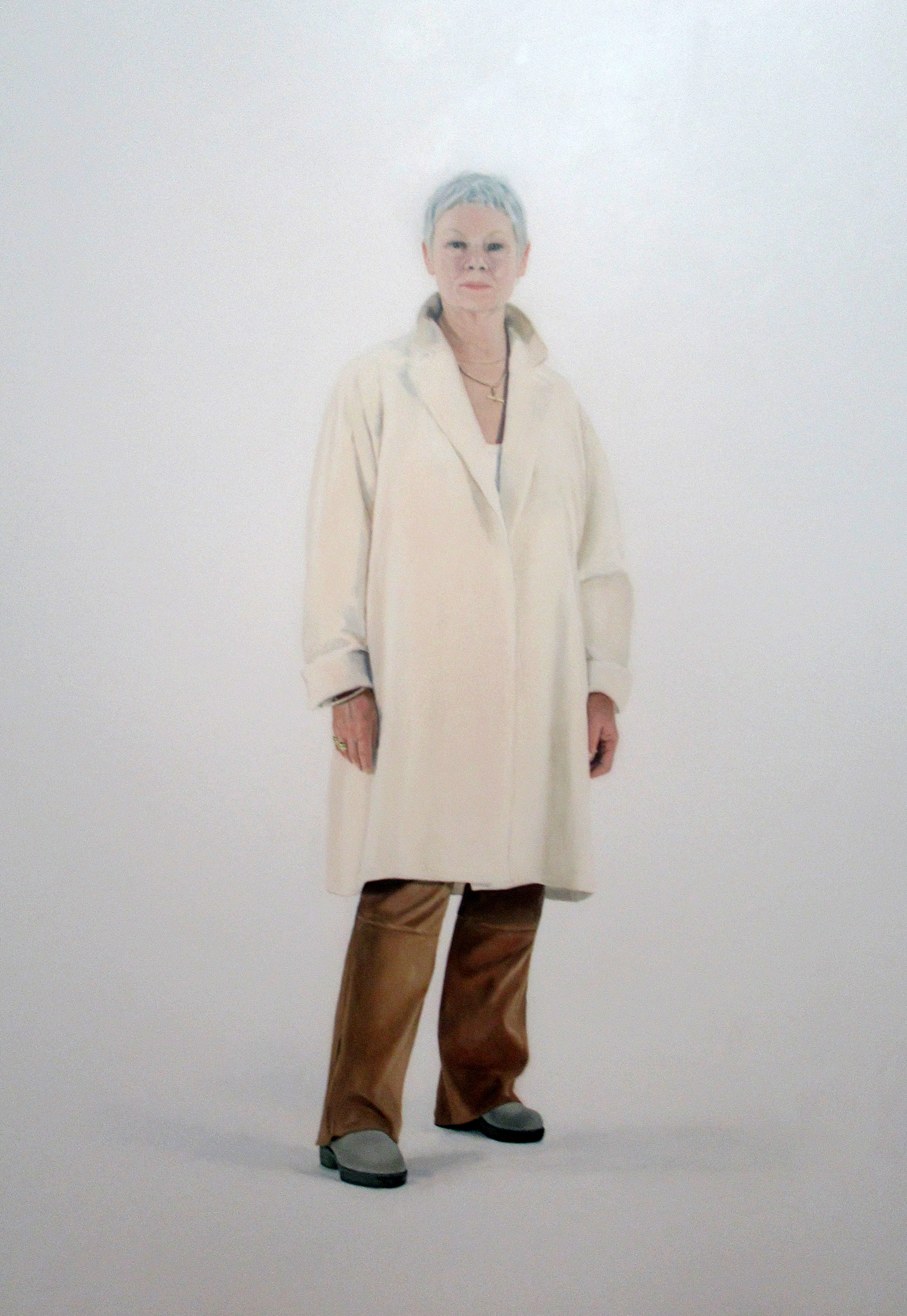
Judi Dench, b. 1934, by Alexxandro Raho

Dench has played many different roles, from Ophelia in Shakespeare's Hamlet to M in the James Bond films. However, Raho chose to portray the actor off-stage, as a version of herself in her everyday clothes, unadorned and without props. The artist has spoken of how he attempted to 'trap something I saw while she waited in the foyer of the National Portrait Gallery, unaware of me' when they first met. Raho's process involves taking hundreds of photographs, yet the portrait retains painterly qualities such as the delicate brush strokes and soft tonal effect, which make the figure appear to shimmer.


Amy-Blue, Any Winehouse, 1983-2011, by Marlene Dumas

Many portraits in the collection are painted from life, but this painting of Amy Winehouse, the Grammy-winning singer and songwriter, was made in commemoration following her death at the age of 27. Moved by the news, the artist searched through images of Winehouse on the internet. Dumas cropped and simplified the singer's characteristic features, choosing to include the dramatic sweep of eyeliner but not her recognisable beehive hairstyle. The translucent blue colours refer to Winehouse's troubled life and her musical influences. She encompassed genres including soul, R&B and jazz. Her voice was described by journalist Jenny Elisco as 'husky and sultry and sad, like a broken heart marinating in whisky and cigarette smoke'.