Jesse Darling, No Medals no Ribbons
At Modern Art, Oxford.
Jesse Darling has explored how systems of power - government, religion, ideology, empire, technology - can be as fragile and changeable as mortal bodies.
Her work often addresses the fragility and impermanence of life, highlighting that 'nobody gets out of here alive, and nothing is too big to fail'. Even though mortality is an important theme in her work, there is also a hopeful message: that vulnerability is also a strength, and adaptation, resilience and change can be empowering. 'For me it's a hopeful feeling to know that even empires fall, kings topple, and governments are overthrown. To know that everything has its own end, even when it seems like the reign will be endless. Vulnerability is a given, like it or not, in everybody. It's what makes us alive. It's not that vulnerability is in itself a strength, but the fact that our mortality, our propensity to suffer in love, in conflict, under structural violence, and our animal need for nourishment and warmth is what our species has in common. Universalism is such a melancholy white European thing but I'm attached to it because I believe in coalition and community despite everything. To acknowledge our universal vulnerability, at the level of the mortal body, is for me a way of thinking about trying to care for each other'.
She mainly uses recycled materials for her work: 'for most of my practice I just use what is cheap or free and easy to find. There's poetry in objects that everyone is able to recognise from their daily lives, like a shortcut to meaning. I find myself drawn ambivalently to petrochemical materials - steel and plastic, silicone. Plastic in particular is a zombie medium - bright, lurid, doesn't really decay - and it's made from fossil fuels, which in a certain sense can be seen as the exhumation of the ancestors. Steel is the technology of coloniality and capitalism - industry, war. These materials have produced my body, in a manner of speaking, and theu tell their own stories. You could say it's autobiographical, but my autobiography isn't just about me - it's a story about the Enclosures Act, the Industrial Revolution, the Britsh empire, the transatlantic slave trade, Henry Ford, Walt Disney, the World Wars, mines and miner's strikes, the welfare state and its dissolution, the failed sexual revolution, Margaret Thatcher, Tony Blair, the twin towers, Brexit and Covid 19'.
The meaning behind the exhibition title is a repudiation of the whole triumphant 'retrospective' thing that goes along with a survey exhibition. It's also secretly a reference to a distant relative of Darling's whose story she came across recently. As a German prisoner of WWII he started fabricating artificial legs for his injured comrades from pieces of window frames, metal chairs, cotton batting, rubber from old tires, camp scrap and anything he could get, bribing the guards with chocolate and cigarettes for stove fuel. According to local news stories he made up to 300 artificial arms and legs, some of which had complicated jointing mechanisms. When the war ended and they sought him out for recognition and decoration, he refused everyone saying that it was best to forget what had happened. His materials list looks a lot like Darling's .
The large gallery:
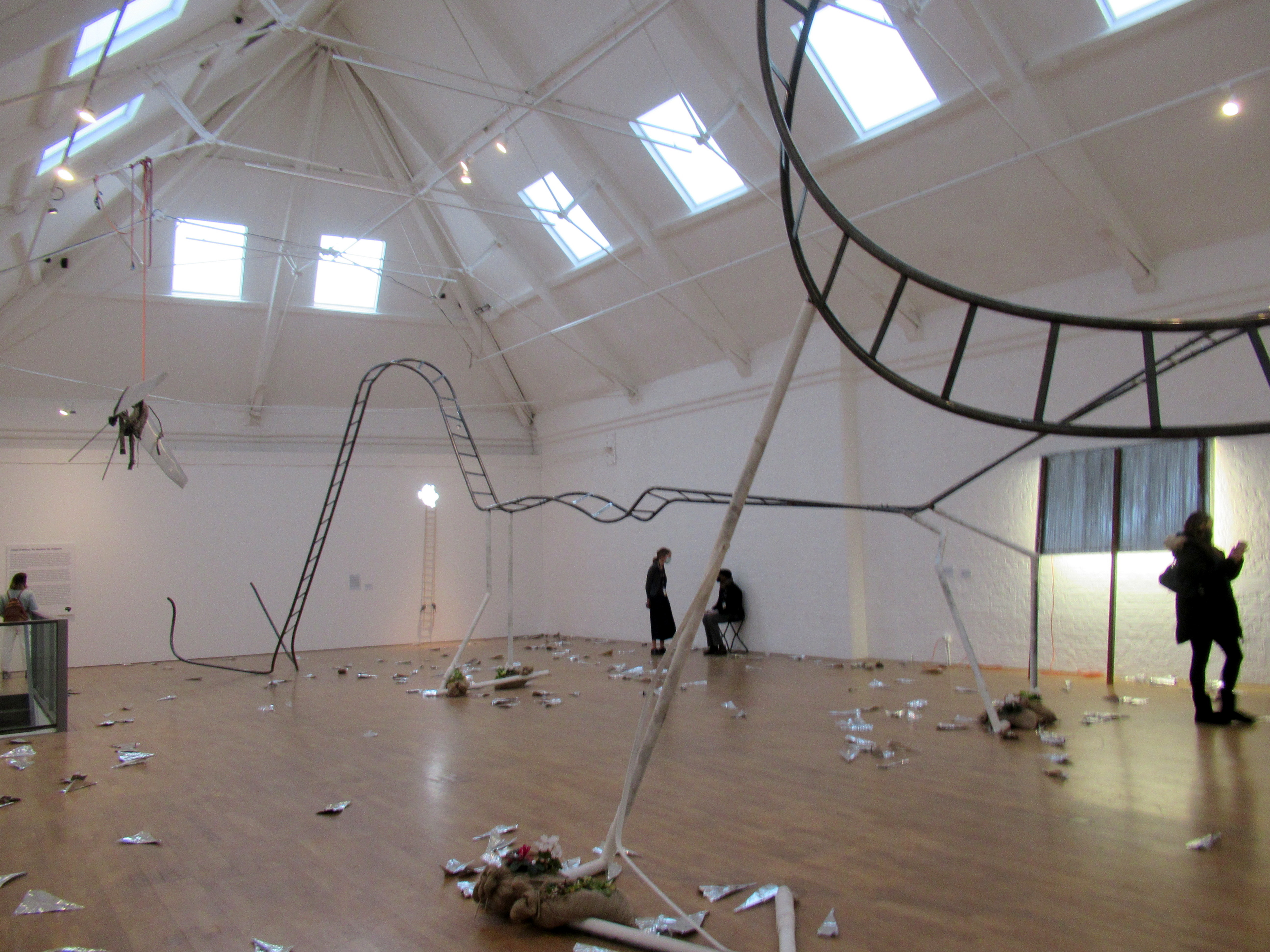
Gravity Road, 2020, (steel, jute, sand, soil, flowers, elastic bandage, metal coating)
Constructed in Pennsylvania in 1827, the original Gravity Road was a precursor to the modern rollercoaster and one of the first railway lines in the USA - a stretch of slopping railroad track that carried coal downhill by the force of gravity alone. By the 1850s, the rapid descent of Gravity Road (as it became known) was a popular attraction of working families to ride.
Here, Darling twists and bends steel tubes to create a dysfunctional roller coaster, underlining parallel histories of coal mining and extraction. The sculpture highlights how technologies of labour were appropriated to create amusement parks as 'leisure time' experiences for industrial workers who would seek out the death-defying thrill of the rollercoaster 'happiness machine'.
Darling's steel construction calls to mind the reconstructed skeleton of a dinosaur or woolly mammoth in a nod to histories of museums. The faulty track winds its way around the room like a deformed monument to a modern age that celebrated progress and acceleration yet produced violence.
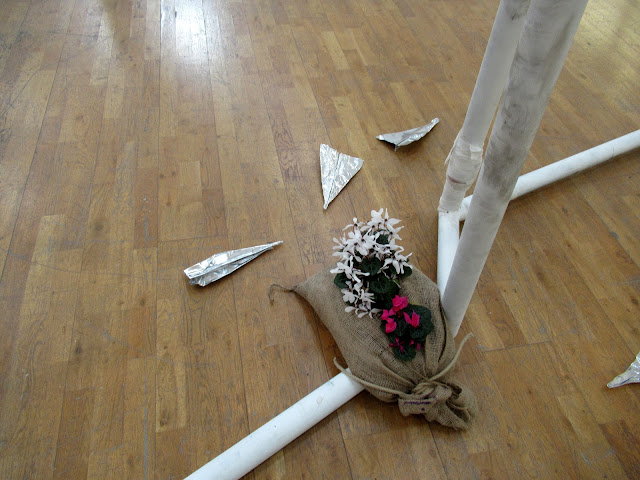
The buckling steel feet, carefully bandaged in places, are weighed down by sandbags planted with flowers.
The continued ideological and material impacts of industrialisation are present throughout Darling's work. Technological progress and economic growth, innovation, and automation led to the emergence of leisure societies, the entertainment industry, and the exhibition, or museum format as we know it - developments that can equally be seen as stories of control, exclusion, and exploitation.
Against the north facing wall, Ascension Device for Birds 2018-2022, (wooden bird ladders, PLA, electric wire)
On the east facing wall,
Embarrassed Billboards, 2016/2022, (galvanised steel, mild steel, wood, fluorescent tubes)
Drawn to the hidden architecture of advertising displays, Darling imagines the emotional life of a pair of 'embarrassed' billboards forced to relentlessly sell consumer products in public for hours on end. The two fabricated signs lean their illuminated faces to the wall, turning their backs to the viewer in an ambiguous act of refusal or physical exhaustion.
The aluminium paper leaves (Planes, 2019) which are scattered across the gallery floor, are too heavy to fly. These grounded planes invite us to reflect on the normalised phenomenon of international travel. Those with enough money and the right documents are permitted the transnational crossing of borders, but this luxury is dependent on natural global resources that will soon be exhausted.
Airplanes appear throughout Darling's work, symbolising debates around the environment, travel and migration.
Hanging from the ceiling,
Saint Icarus (attributes), 2018, (wood, aluminium, rucksack straps, ratchet straps
On the ceiling,
Domestic Terror 2016, (steel, cloth)
The small gallery:
Darling's ongoing exploration of the relationship between human biology and politics is central to the artworks in this gallery. Photographs documenting the medicines, cosmetic and sacred charms used by Darling daily offer unconventional and intimate portraits of the artist. By drawing attention to the mundane substances and spiritual devices that keep us alive, Darling highlights how bodies depend on different technologies and beliefs. The artist is interested in the 'fungibility and failibility' of the body, the potential for living beings to adapt and chance, to fail and heal. The capacity for physical transformation is further alluded to via a boxing glove holding a plaster cast model of a foetus, creating a touch image of parenthood.
Plastic carrier bags feature throughout Darling's work. They appear in photographs of supermarket bags splayed into crucifix formations and are stretched in sculptures as flimsy torsos precariously held in place by steel. Darling is drawn to the bodily aspect of these throwaway objects. They understand a plastic carrier bag as both an object made to contain consumer products and a metaphor for the physical human form, something which the artist subjects to dissection. Darling has referred to plastic as a 'zombie medium' that threatens to outlive us all. The use of plastic references the politics of austerity, purposely seeking out bags from low-budget brands to express a physical form and collective body caught between exhaustion and survival.
Collapsed Cane, 2017-2022, (steel, aluminium, rubber and lacquer)
Gun 2, 2022, (broom, litter picker, crutch, plastic bottle, pigeon spikes, pencil, car air freshener, wire, plastic flower)
Domestic Terror, 2016, (steel, cloth)
Regalia and Insignia (the staff of Saint Jerome), 2018/2022, (steel shower head and cable, crutch, plastic, electrical wire, harness, tape, spray paint, finger bandage, perspex, toilet brush, foam packing chips, pigeon spikes)
The Deputation, 2017/2022, Plastic bags, steel)
Honour Role, 2016, (plastic seat, welded steel)

Sphinxes of the Gate (Wounded Sentry), 2018, (steel, cast jesminite, archival foam, packing foam, pet watering bottle, rubber tube, plinth, perspex case)

Darling's sphinx sculptures were first presented in their solo exhibition 'The Ballard of St Jerome' at Tate Britain in 2018, in which the artist revisited the fable of the titular saint. Jerome, a 4th century Christian scholar who translated the Bible from Hebrew and Greek into Latin, was confronted by a ferocious lion while giving a lecture in Bethlehem. Instead of reacting in fear, he recognised that the animal was injured and tamed the lion by nursing its wounded paw back to health, gaining the animal's eternal loyalty in return. The story was a favourite subject for artists in the Renaissance period, with the lion representing the taming of wild nature and Jerome representing knowledge and restraint. For Darling, the fable narrates a complex power dynamic of mutual power and vulnerability. She describes it as 'a love story, but also a story about sovereignty, captivity, the domestication of otherness'.

At Tate Britain the sphinxes flanked the entrance to Darling's exhibition alluding to the ubiquiy of large felines at the threshold of countless institutional buildings, including the British Museum, whose entrance is guarded by two stone lions. Encased in glass cabinets used to exhibit artworks, the sculptures also subvert the convention of museum display to question how meaning and value are assigned through the authority of institutions.
Votive, 2016/2022, (wax, plastic, LED, cotton, steel)
The altarpiece-like Votive employs what is perhaps this millennium's heaviest symbolic object: an airplane. In this work, it has been fashioned into a small wax candle and swaddled in bandages, like a wounded bird or broken superhero figurine. Supported by a church sconce, the sculpture recalls the 'Ex-Voto' beeswax body parts used for ritual prayer in shrines or chapels where the worshiper seeks grace or wishes to give thanks for healing. Darling's solemn treatment of this small and damaged object transforms it into a piece of fragile iconography - a prayer for grace in a time of collapse.
The gallery at the back:

In this gallery Darling brings together a 'menagerie of sculptures' made over the last decade. Curved and bent figures rendered in steel suggest the human body, while other living being, such as horses and lions are conjured through metal wire and readymade objects. A common theme underpinning Darling's work is the idea that 'to be a body is to be inherently vulnerable', which the artist explores by assembling her work around material forms of debility. Darling's bent and curved pieces are stand-ins for unruly bodies. Crutches and walking aids prop up sculptures, while the legs of chairs and cabinets are dramatically injured with kinks and bends making unstable supports. Collectively these works evoke the body's vulnerability and express the desire to resist the social and political constraints imposed on our lives. These anthropomorphic works convey injury and fragility, but also resilience. They encourage us to think about vulnerability and dependency as a crucial part of what makes us human beings.

Elsewhere Darling repurposes display cabinets commonly found in museums to critique the production of knowledge within Western institutions. Objects including toy birds and archival folders filled with concrete are presented inside vitrines or Perspex boxes to recall '
the sense of a pinned butterly, something that could otherwise have lived in the wild but never will now'. Like Darling's figurative sculptures, these cabinets are either supported by mobility aids or appear so crushingly heavy that they collapse under their own weight. The artist borrows from traditional display devices to visualise established systems of knowledge as essentially flawed, rendering them crippled and implicating the museum and gallery in this process.
Le Baiser (no more Saint Jeromes), 2017, (polysterene, plaster, silicone, cotton, plastic)
We got another one over here, 2019, (paint marker, pastel and paint on paper)
Saint Batman, 2016, (welded steel, sugar, antivirus mask, expanding foam, plastic)
Material Girl, 2014, (steel, plastic, rope)
Virgin Variations, 2019
A series of wooden cabinets, resembling the makeshift 'shrines' of high school lockers, or memorial walls adorned with gifts for remembrance in cemeteries. These cabinets are substitutes for absent bodies. Together, they become an alternative memorial for the legend of Saint Ursula, who, along with her 11,000 virgin followers, was murdered and buried in Cologne. Each cabinet evokes a sense of absence, or an empty tomb, while also attempting to imagine the 'virgin' that inspired it. Collectively, the works commemorate the precarious lives and bodies that history doesn't care to name or remember.
Epistemologies (collapsed cabinet), 2018/2022, (steel, crutch, perspex, birds, foam chips)
Regalia & Insignia, 2018, (steel, silicone, spray paint, pack straps, ECG stickers, dog muzzle, finger pen, jermonite, butcher hooks, broken bone, bird, perspex)