Showing posts with label resistance. Show all posts

Sunday, 14 October 2018

Resistance - Art in the dark years, 1967-1974


Resistance - Art in the Dark Years, 1967-1974, at the Contemporary Greek Art Institute, Athens.

Dark years indeed, one of the worst periods in Greek history. On April 21, 1967, a group of right-wing army officers seized power in a coup d'état. This was a result of a culmination of 30 years of national division between the forces of the left and the right that can be traced back to the time of the resistance against the Axis occupation during WWII, which was followed by a civil war fought between the communist forces and the now-returned government-in-exile. The coup was aided by the British government, which under the prime ministership of Winston Church was determined to half the Soviet encroachment in the Balkans, and by the United States which, under the Truman Doctrine, had began to actively support a series of authoritarian governments in Greece, Turkey and Iran.

The colonels were able to seize power quickly by using elements of surprise and confusion. Tanks were placed in strategic positions in Athens, effectively gaining complete control over the city. At the same time, a large number of small mobile units were dispatched to arrest leading politicians and ordinary citizens suspected of left-wing sympathies according to lists prepared in advance.

By the early morning hours the whole of Greece was in the hands of the colonels. One of the most vivid memories of my teenage years is waking up in the morning, getting ready for school. I left the house, and I remember standing in the garden, surrounded by this eerie silence. A passer-by, the only person around,  who saw me standing there, said to me that I needed to go inside and stay inside, as I would not be able to leave the house that day. And this is what I did. We stayed indoors for a few days. The coup d'état was announced over Greek radio, martial music was continuously broadcast, interrupted from time to time with announcements of the junta issuing orders, which always started with the introduction 'we decide and we order'. Political freedoms and civil liberties, which up to then had been taken for granted, were suppressed. Democracy had been dismantled. Freedom of thought and freedom of the press were suspended. Torture became a deliberate practice carried out by both the Security Police and the Greek military police, with an estimated 3,500 people detained in torture centres. Commonly used methods of torture included, but were not limited, to: beating the soles of the feet, sexual torture, choking and ripping out body hair, continuous standing in an empty room, sleep and food deprivation, beatings and loud sounds.

According to a human rights report by Amnesty International, in the first month of the coup, an estimated 8,000 people were arrested. A psychology of fear pervaded. Surveillance of citizens was a fact of life, even during the few permitted social activities. Photography was banned in public locations. The country had become a true police state.

Seven years later, the collapse of the junta was triggered by a series of events,  the pressure of the Turkish invasion of Cyprus being the catalyst.

The works of art in this exhibition were created during those dark years, some are overtly political, some covertly. Many were produced abroad.


Vlassis Kaniaris, Red carnation, 1969


A. Tassos, The Torture and Death of Electra Apostolou, 1967


Vangelis Dimitreas, Demonstration, 1968 (ink on paper)


Asandour Baharian, The Prison in Kerkyra, 1972


Kyriakos Kantzourakis, Che, 1968, (oil on canvas)


Kyriakos Kantzourakis, The Exception, 1968, (oil on canvas)


Cleopatra Digga, Mirror, 1972 (acrylic)


Leda Papakonstantinou, Hello, How Are You? Are You Well?, 1974


Photograph of Leda Papakonstantinou with the sculpture


Vasso Kyriaki, Vietnam, 1968, (collage and acrylic)


Yannis Yaitis, Che Guevara's Funeral, 1968, (oil on canvas)


Demosthenes Skoulakis, Days of 1967, 1970, (oil on canvas)


Vasso Katraki, Antigone's Debt, 1972


Demosthenes Kokkinidis, Mother and Child, 1968-69, (acrylic on fabric)


Vasso Katraki, Remembering Panagiotis Elis, (engraving on stone)


Cleopatra Digga, Politicians, 1972


Yiannis Valavanides, Untitled, 1973, (tempera on paper)


Vasso Katraki, Pebbles painting while on exile, Gioura, 1967


During the junta years political prisoners were incarcerated in concentration camps on arid islands where some were kept there for years: this is most commonly referred to as exile.  Makronisos is the most infamous one. Vasso Katraki was arrested on the first day of the coup. She spent nine and half months there, suffering hunger, thirst and beatings. She was a life-long resistance fighter, and was also involved in the National Liberation Front (EAM) resistance movement opposed to the German occupiers of Greece during WWII.


Vasso Katraki, etching created while she was in exile in Gioura


Vasso Katraki, etching created while she was in exile in Gioura


Vourvoula Skoura, record sleeve of Mikis Theodorakis' double album 'Theodorakis directs Theodorakis' 1971-73


The lyrics of Antonito El Camborio, by Frederico Garcia Lorca, one of my favourite Theodorakis songs, so I have downloaded it on YouTube, sang by Maria Farantouri.


Theodorakis left Greece during the junta, as did Maria Farantouri. They went to Paris where they worked, produced albums and went on world tours, sending a very strong political message against the junta. Theodorakis' music gave those of us, who were in Greece, hope and courage. We used to go to night clubs, called boites at the time, clandestine places, where we would listen to live renditions of his music - one of the few forms of resistance for many people.


Saturday, 17 June 2017

Kaethe Kollwitz in Berlin


Situated in a leafy residential street in West Berlin  


the Kaethe Kollwitz Museum in Berlin, is a real gem.


One of the artist's sculptures (Mother and Children) in the front garden


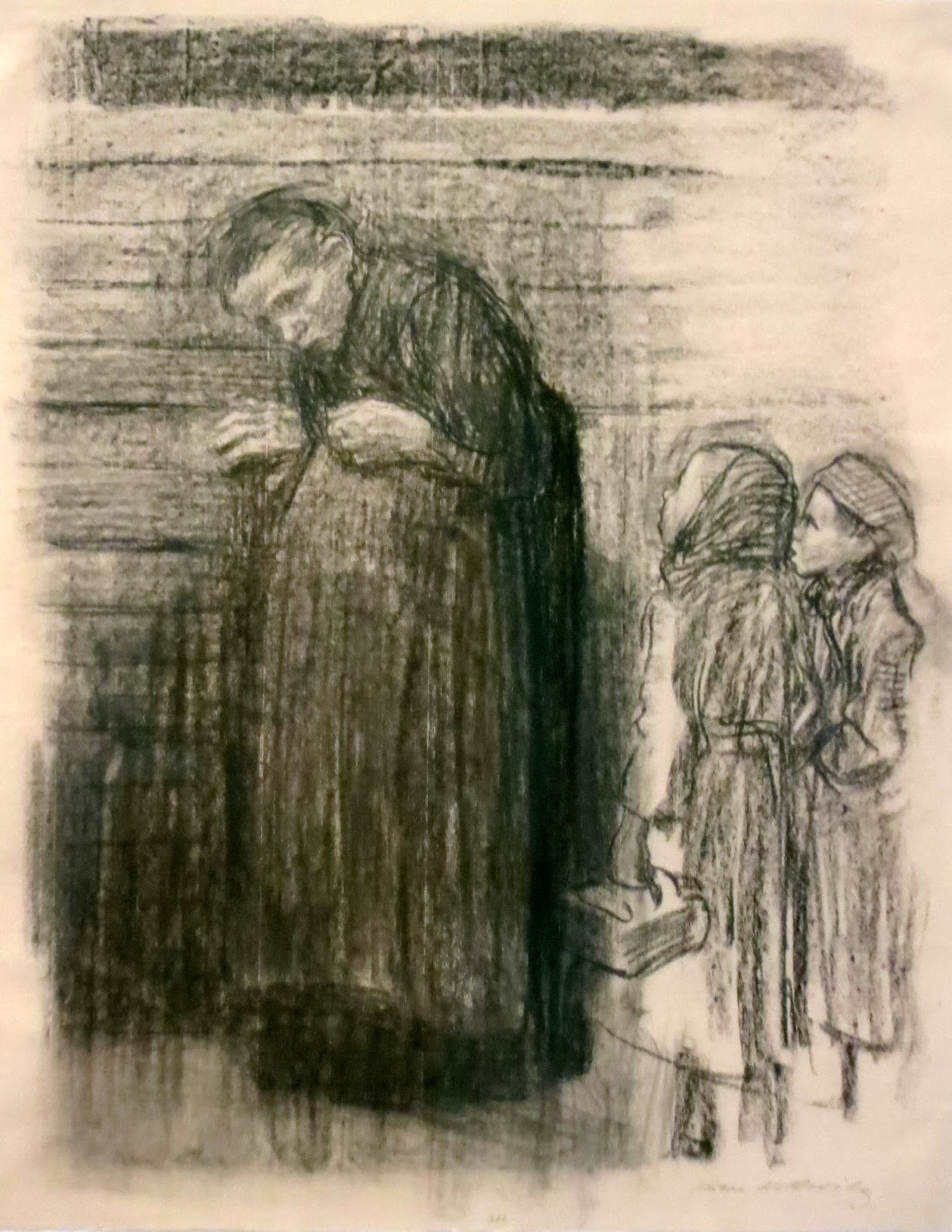
Kollwitz worked as a painter, printer and sculptor. Her printmaking work includes etching, lithographs and woodcuts. Despite the realism of her early works, her art is now more closely associated with Expressionism which together with the Bauhaus were major influences in her later years. The themes of most of her work are the effects of poverty, hunger and war on women and the working class. She was the first woman elected to the Prussian Academy of Arts.


Her husband tended to the poor in Berlin where the couple moved into the large apartment that would be Kollwitz's home until it was destroyed in WWII. The proximity of her husband's practice proved invaluable:

'the motifs I was able to select from this milieu (the workers' lives) offered me, in a simple and forthright way, what I discovered to be beautiful... People from the bourgeois sphere were altogether without appeal or interest. All middle-class life seemed pedantic to me. On the other hand, I felt the proletariat had guts. It was not until much later... when I got to know the women who would come to my husband for help and incidentally also to me, that I was powerfully moved by the fate of the proletariat and everything connected with its way of life... But what I would like to emphasise once more is that compassion and commiseration were at first of very little importance in attracting me to the representation of proletarian life; what mattered was simply that I found it beautiful'.
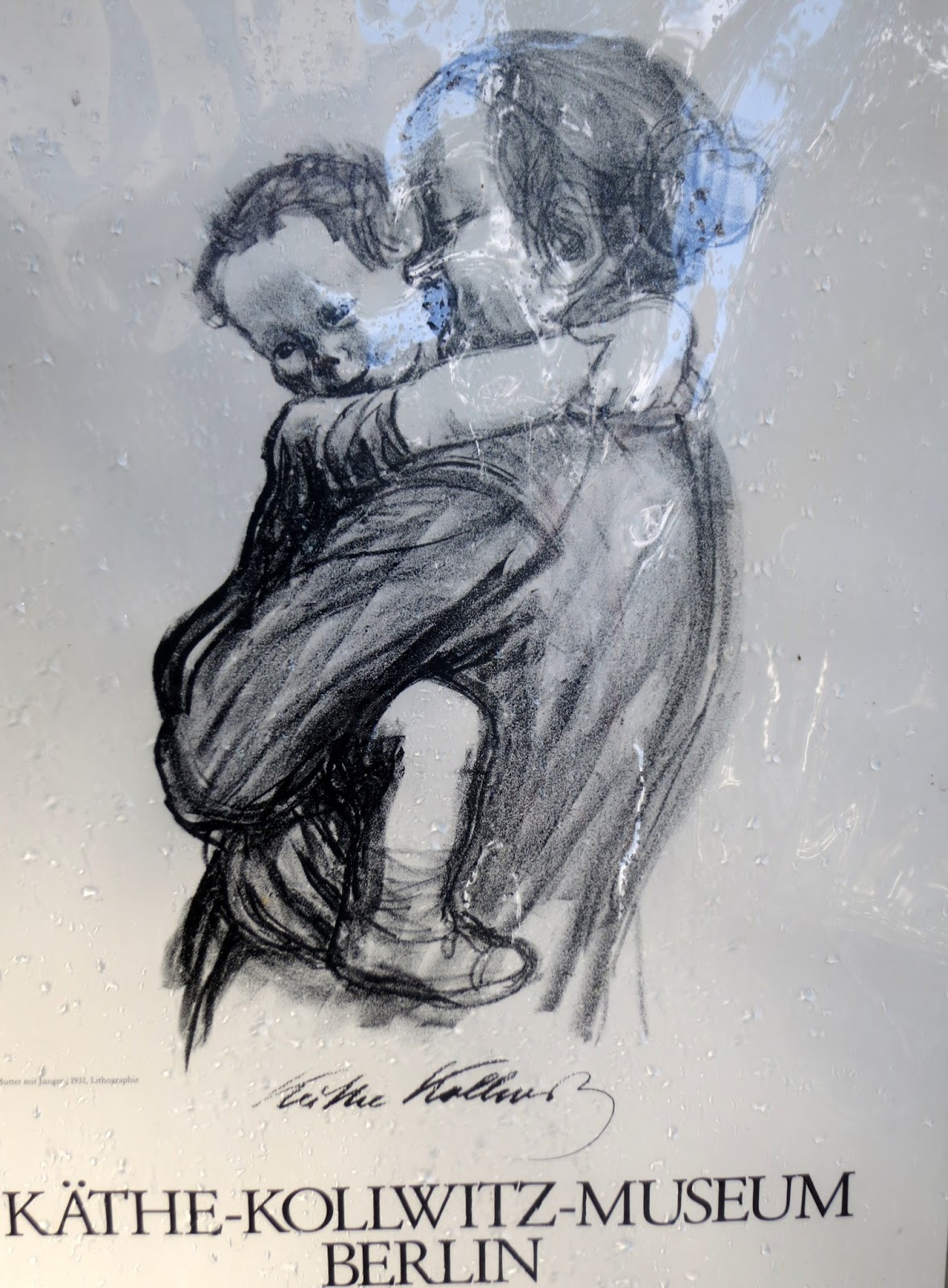

The works in this post are not necessarily the ones I liked best, or what I thought were the most representative of her oeuvre, but the ones that did not have reflection from the glass. I am not pleased with the quality of any of the images I have reproduced here, but I needed to do this post.


Colour drawing for Pieta, 1903


Self-portrait, (charcoal drawing), 1916


Hans Kollwitz with Nurse, (pen and ink drawing), 1894


Woman with Pained Face, (pencil drawing), 1900


Female Home Worker, (charcoal drawing), 1906


Poster for German Cottage Industry Exhibition in Berlin, 1906


Child in an Accident, (charcoal drawing), 1909-10


Christmas, (charcoal drawing), 1909


Welcome, (etching), 1892


Self-Portrait, (pen and ink drawing), 1890

The Weavers' Revolt, 1893-97:

A series of three lithographs and three etchings about the Silesian weavers' revolt of 1844: weavers protested against low wages and their revolt was crushed. Their desperate situation became public knowledge: Heinrich Heine wrote a poem about the revolt, and Gerhart Hauptmann, a play. Kollwitz saw a performance of this play in 1893 which prompted her to examine this conflict in more detail. Not a literal illustration of the drama, the works were a free and naturalistic expression of the workers' misery, hope, courage, and eventually doom. The series was a huge success and became her most widely acclaimed work.


Need, (lithograph)


Death, (etching)


Conspiracy, (etching)


March of the Weavers, (etching with aquatint and sandpaper)


Storming the Gate (etching with aquatint and sandpaper)


The End (etching with aquatint and sandpaper)
The Peasant War:

Kollwitz's second major cycle of works was the Peasant War. The German Peasants' War was a violent revolution which took place in Southern Germany in the early years of the Reformation. Peasants who had been treated as slaves took arms against feudal lords and the church. This too, ended in bloody defeat. Contemporary uprisings inspired Kollwitz to produce these works. The initial source of Kollwitz's interest in this revolt dated to her youth, when she and her brother Konrad playfully imagined themselves as barricade fighters in a revolution.


Black Anna, (chalk drawing)

The artist identified with the character of Black Anna, a woman cited as a protagonist in the uprising.
Works in this series include: Plowing, Raped, Sharpening the Scythe, Arming in the Vault, Outbreak, After the Battle (which features a mother searching through corpses in the night, looking for her son), and are Kollwitz's highest achievements as an etcher. Unfortunately, none of my photographs of those came out without reflection so I am unable to include them.


Later works:

For Kaethe Kolwitz, old age began at the age of 47 when her younger son, Peter, died. As a war volunteer, he was killed during WWI. She bore a heavy sense of guilt for not stopping him.

It was then that she discovered wood-cutting with its hard lines, and henceforth renounced the smooth and smaller format of etching. She found more energetic and simpler forms.


Seed for Sowing Should not be Milled, 1941-42, (chalk lithograph)


Death is Recognised as Friend, 1937, (chalk lithograph)


Bread! 1924, (limestone printing block)


Mother with Young Boy, 1933, (lithographic limestone printing block)


Parents with Child, 1931, (lithograph)


Mothers, Share your Abundance! 1926, (lithograph)


the printing block


Help Russia (poster without text), 1921, (lithograph)


Head Study of Karl Liebknecht on his Deathbed, 1919, (chalk drawing)


In Memoriam Karl Liebknecht, 1920, (woodcut)


Self-Portrait, 1922, (woodcut)


Pensive Woman, 1920, (chalk lithograph)


War, (one of seven lithographs), 1921-22


Kollwitz's printing press was discovered in the 1970s together with the lithography stones for Bread and Mother with Boy. The press and stones can be traced back to the time of WWII


Lithography is a planographic process. The chalk drawing is rich in grease. If the limestone is then wetted with a sponge, and colours containing grease are applied lightly with a roller, only the greasy parts accept the ink. Water and grease repel each other.