Showing posts with label stained glass. Show all posts

Wednesday, 25 June 2025

Bristol - the Cathedral


Bristol Cathedral was originally an abbey dedicated to St Augustine, founded in 1140 and consecrated in 1148. It became the cathedral of the new diocese of Bristol in 1542, after the dissolution of the monasteries. It is a Grade I listed building.


The vaulting is quite amazing


Very little of the original stained glass remains, with some being replaced in the Victorian era and there were further losses during the Bristol Blitz.


The most recent glass is an Abstract Expressionist interpretation of the Holy Spirit designed by Keith New in 1965 and installed here, in the South Choir


Some of the most recent stained glass is by Arnold Wathen Robinson following damage during the Bristol Blitz of 1940 and 1941. These include depictions of local Civil Defence during WWII including St John Ambulance, the British Red Cross and the fire services along with air raid wardens, police officers, the Home Guard and the Women's Voluntary Service.


A Victorian era window under the Cathedral's clock, marked 'to the glory of God and in memory of Edward Colson' was ordered to be covered in June 2020 in advance of its eventual removal. The Diocese of Bristol also decided to remove from the Cathedral other dedications to Colston after the toppling of the late 19th century statue of Colston in the city centre on 7 June 2020. The legacy of Colston and his involvement in, and profit from, the transatlantic slave trade in enslaved Africans became toxic and came to a head after the murder of George Floyd in May 2020.


A late Saxon panel of the Harrowing of Hell, dating from before the Norman Conquest tat may have been carved around 1050. Following a fire in 1831, it was found being used as a coffin lid under the Chapter House floor.


Madonna and Child with Joseph by Zimbabwean artist Chinyama. (1966)


This corridor is a remnant of the cloister, a square of such passages that connected the buildings of the monastery to each other and to the church. It was rebuilt in the 15th century.


Some of the stained glass here dates form the 14th and 15th centuries.


We then moved on to the Cathedral garden


very peaceful


Refugee, Naomi Blake, 1980.


We left the garden and then heard clapping and shouting, so we went to ingestigate (see here )

Sunday, 24 June 2018

John Piper at the Mead


John Piper


at the Mead Gallery, University of Warwick.

Landscape artist, official war artist, a major advocate of abstract art, John Piper is one of the most significant British artists of the 20th century. This exhibition at the Mead Gallery at Warwick University shows how Piper worked across an extraordinarily diverse range of artistic disciplines.


Beach and Starfish, Seven Sisters Cliff, Easterboune 1933-34 (gouache, pen and ink with paper and fabric collage)


Hope Inn, 1934, (gouache and Indian ink with collage)


Houses in Surrey, 1928, (oil paint on board)


Foreshore with Boats, South Coast, 1933 (oil with printed paper on canvas)


Fishing Boars near Newhaven, 1934, (oil with collage)


Drawing for a Construction, 1934, (ink and gouache with collage on paper)


Construction Intersection, 1934, (oil and wooden dowels on canvas)


Construction 1934, 1967, (oil, zinc, wood, glass and dowelling on canvas on plywood)

Piper's abstract constructions were the first works he made after visiting Paris in 1934. They were only exhibited once as a group, in the foyer of the Experimental Theatre in Hampstead in early 1935, alongside works by Wassily Kandinsky, Joan Miro and others. He is known to have made around fifteen in total, but few have survived as the artist did not take great care of them after their making. He ultimately came to regard the abstract style as an 'exercise'. This piece was initially dismantled before being reconstructed by the artist in 1967, following a photograph and using some original elements.


Brighton, Regency Square, 1949, (oil on canvas)


Portland Stone Perspective, 1954, (oil on board)


Rocks on the Glyder Mountain, 1951, (oil on canvas)


Interior of Coventry Cathedral the Morning After the Blitz, 1940


Cartoon for Baptistery Window, Coventry Cathedral, 1956, (ink, crayon and pastel on paper)


Abstract 1956, (screen-printed rayon)


Abstract Composition, 1935


Wednesday, 27 April 2016

Ruprechtskitche in Vienna


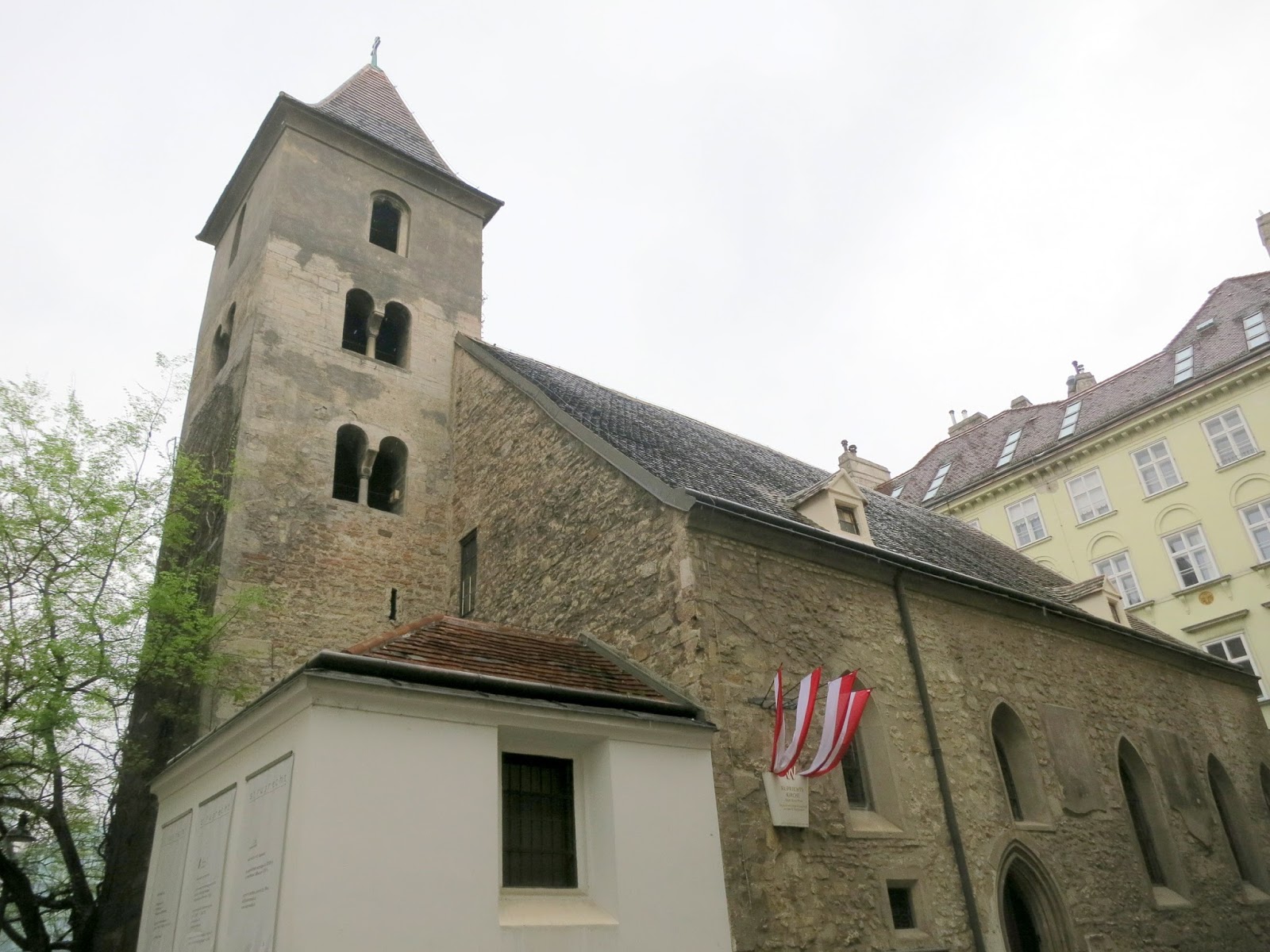
Ruprechtskirche in the Jewish Quarter in Vienna

This Romanesque church is traditionally considered to be the oldest church in the city. It's dedicated to Saint Rupert of Salzburg, patron saint of the salt merchants of Vienna. It's been rebuilt and altered many times in its history. In 1276, it was damaged by fire and modified.

The tower was built in the traditional Romanesque style including the typical double windows. Two of the still functioning bells date back to the 13th century. These bells are up to this day attached on their holdster without screws.

The renovations at the end of the 20th century primarily focused on the basic structure of the building as well as preparing the interior for more contemporary services. They tried to achieve quality and plainness and they have succeeded beautifully in this.


We visited this church on a Sunday while a service was going on. I was so taken by the interior and the stained glass windows in particular,  that we came back on our last day to have a proper look and to obviously, take some pictures.


The dominant feature of the main chapel is a baroque style crucifix that dates back to at least 1765.


The interior is very pleasing to the eye - beautifully proportioned, plain and austere.

The base stones of the altar are Romanesque, but in 1703 a baroque styled high altar was built around these base stones. It was removed in 1986 to achieve a plainer look. Since then the community gathers around the altar during the services.


This wonderful little church is glorified by the very brightly coloured stained windows designed by Lydia Ropport in the early 1990s. They are magnificent.


It was very difficult finding much about Roppolt. She studied in Vienna and painted portraits and landscapes in the tradition of late expressionism.


The stained glass windows are glorious - I have included most of them here


Three pillars separate the main chapel from the side chapel.


I have searched and searched, and could not find anything about this cross


On the north wall of the church stands the sarcophagus of St. Vitalis a martyr from the Roman catacombs. The skeleton is clothed in baroque style garments. Missing body parts were replaced with wax replicas.