Monday, 10 December 2012

The Tanks at Tate Modern


During our last visit at Tate Modern we went to see the Tanks, the three buried concrete cylinders that held the fuel that powered the turbines, that generated electricity for a large section of London. Each has a height of 7 metres and a diameter of 30m, made of concrete in order to withstand the risk of explosion.


They were converted by Herzog and de Meuron, whose approach was largely to let the size and mass of the cylinders speak for themselves. One of the cylinders has been converted into a performance space, another for temporary installations and the third one has been subdivided into small areas to serve as dressing rooms, toilets, etc.


With an exhibition area of 1,800 sq metres, there is a lot of scope here.


 'It is an underground space. Each tank has a door and that's it. It's just very straightforward',  stresses Jacques Herzog. 'It is mostly good advice to disappear, as you leave your traces anyway. It looks as it has been so forever but it was actually different before', adds Pierre de Meuron.


This is a small, round room, with a diameter of 3-4 metres, dark, womb-like. I do not know what the function of it was.

                                           
Suzanne Lacy, The Crystal Quilt, 1985-87


Suzanne Lacy, The Crystal Quilt, 1985-7 Photo: Gus Gustafson LIMITED

On 10 May 1987 in the central atrium of the Crystal Court shopping mall in Minneapolis, 430 women over the age of 60 took part in this performance, dressed in black and seated at tables arranged in a pattern based on a quilt designed by painter Mirriam Shapiro. The women shared their views on growing older. An accompanying soundrack by the composer Susan Stone mixed the voices of 75 of the women with personal observations interspersed with social analysis. Witnessed by 3,000 people the women talked and moved their hands at prearranged intervals in gestures choreographed by Sage Cowles. The performance ended with the audience joining the stage, transforming the formal pattern of the quilt. The resulting performance, The Crystal Quilt, was broadcast live on television. The event was an attempt to consciously comment on the representation of older women in the media.

Lacy has stated: 'In some sense the Crystal Quilt was successful politically, in that the work was bigger, it had more social impact in the region, but do one or two events change the way people - other than those who directly experience it - see? This raises this issue of whether you can expect art to create social change, and at what point it is no longer art'.


The Crystal Quilt now exists in the form of a video, documentary, quilt, photographs and sound piece, combining performance, activism and broadcast in a work that fuses activism and aesthetics.


William Kentridge, I am Not Me, The Horse is Not Mine


The South African artist's eight-channel video installation is simultaneously projected across the walls of the larger space of the Tanks, each film played on a continuous loop. Each film contributes layers to a story that references Russian  modernism, from Soviet film of the 20s and 30s to the calamitous end of the Soviet avant-garde.
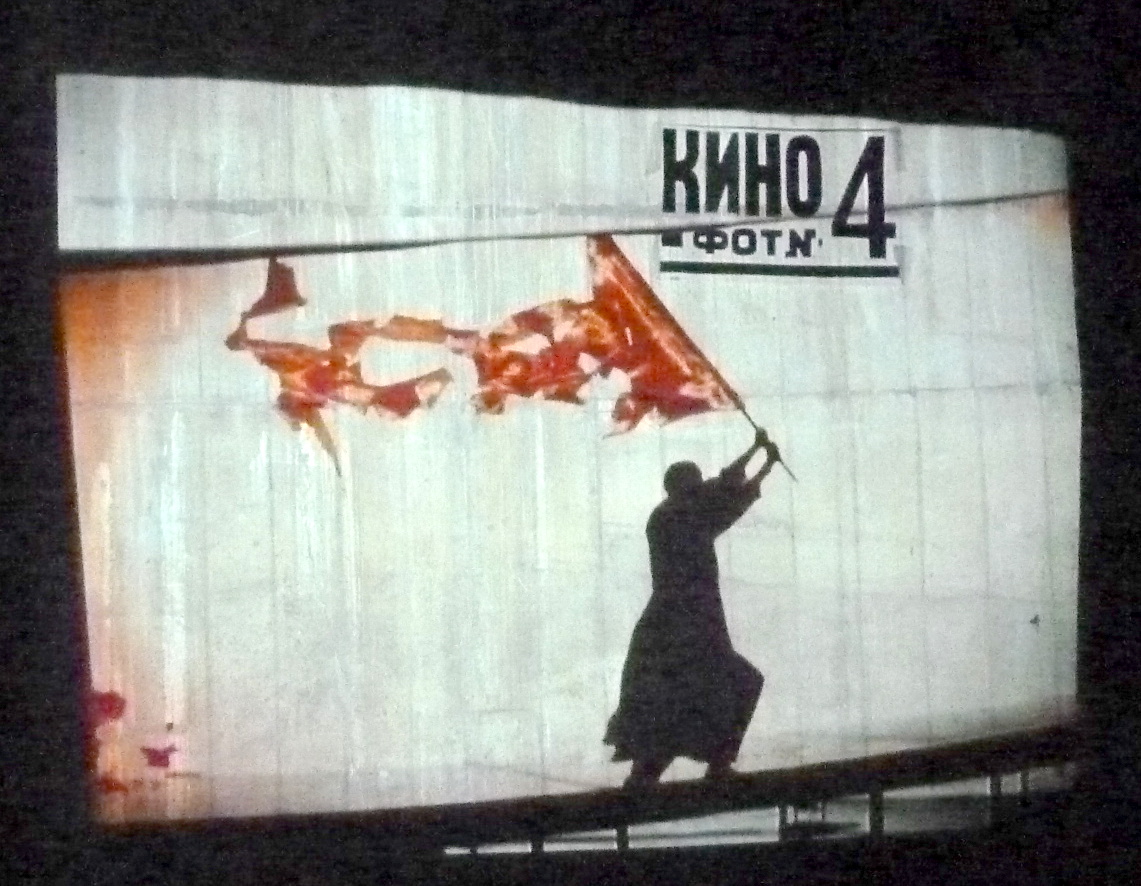


These videos were made as part of the preparation for Kentridge's production of Dmitri Shostakovich's 1928 satirical opera The Nose. The opera is based on Nikolai Gogol's story about an official whose nose leaves his face and develops a life of its own. The title I Am Not Me, The Nose is Not Mine is a Russian peasant saying used to deny all guilt.


The phrase is borrowed from the transcript of a meeting of the Central Committee of the Communist Party at which the Bolshevik politician Nikolai Bukharin - executed during Stalin's purges - attempted to defend himself.


Kentridge has described this work as 'an elegy for the formal artistic language that was crushed in the 1930s and for the possibility of human transformation that so many people hoped for and believed in, in the revolution'.


Friday, 7 December 2012

Tate Modern


Tate Modern.


A few of the works in the permanent collection.


Alberto Giacometti, Seated Man, 1949

Seated Man depicts Giacometti's brother Diego, one of his most frequent models. Even this familiar face became an object of investigation and discovery for the artist who commented 'when he poses for me I don't recognise him'.


Alberto Giacometti, Man Pointing, 1947

This was made very rapidly for Giacometti's first exhibition in New York. He recalled: 'I did that piece in one night between midnight and nine the next morning. That is, I'd already done it and demolished it and did it all over again because the men from the foundry were coming to take it away. And when they got here, the plaster was still wet'. It was originally intended to be part of a larger composition, with the left arm  positioned loosely around the second figure. He later abandoned the idea and considered Man Pointing to be a completed work.


Henri Moore, Upright Internal/External Form, 1952-53

This sculpture reflects the interplay between figurative and abstract forms in Moore's work. 'I have done other sculptures based on this idea of one form between protected by another'  Moore recalled. 'I suppose in my mind was also the Mother and Child idea and of birth and the child in embryo. All these things are connected in this interior and exterior idea'.


Later versions of the sculpture were made in bronze and elm wood and a twenty foot high cast is sited on First National Plaza in Chicago.


Lee Crasner, Gothic Landscape, 1961

Although this is an abstract painting, the thick vertical lines that dominate its centre can be seen as trees, with thick knotted roots at their base. It was probably this that led Krasner to call the painting Gothic Landscape, several years after completing it.

Krasner was married to Jackson Pollock and during their years together she relegated her work to second place so as to support and encourage him and to promote his work. This painting was made in the years following his death and belongs to a series of large canvases whose violent and expressive gestural brushstrokes reflected her feelings of grief.

Wednesday, 5 December 2012

A day in London


We spent Sunday in London. We took the tube to St Paul's and here we are about to cross Millenium Bridge


St Paul's Cathedral behind us


as we cross the bridge, the Shard on our left


it was a gorgeous, sunny, bright day and the light was amazing


view from the terrace at the Tate, Millenium bridge on the right.


I always photograph the trees at the front of the Tate, as I love them


one more photograph


the sky seen through the curtain of the branches


dusk was settling in as we left the Tate


zooming in


and a closer look at the bridge


a last look at the Tate before crossing the bridge.


It was almost dark by the time we got to Covent Garden


how does he do it?


Christmas lights everywhere


that looked so inviting


the Christmas tree outside the market


stunning


listening to the music


the effect of the lights is magical


lots of shoppers


by the Opera.


Monday, 3 December 2012

Through our hands


Through Our Hands, at Leamington Spa Art Gallery and Museum.

The intention of this exhibition is to move beyond utility and practicality and to champion the modern, artistic side of quilt making; to show what a thriving, if little known, art form it is and to increase the awareness of art quilts and their concerns.

The definition of art quilts and the relationship between art and craft is controversial and has often been the subject of lively debate.


Laura Kemshall, Bird in the Hand  (UK)

By using digital collage and digital print Kemshall was able to work on fabric in much the same way as on paper, combining photographs with graphite drawings. These are printed onto cotton fabrics and machine quilted.


Linda Kemshall, Imagining (UK)

This was digitally printed using drawings from Kemshall's sketchbooks in combination with photographs which she took of her moth collection. The machine quilting is free motion.


Sandra Meech, Silent Voice II (UK)

This is part of a series of works based on endangered woodlands. Meech has used ghostly images with minimal colour to illustrate this, with the red/rust representing dying forests in western Canada affected by the pine beetle - a result of warm winters. Photo imagery, paintings and writings are transferred onto cloth which is pieced and machine quilted.


Dijanne Cevaal, Traveller's Blanket with Circles, (Australia)


Annabel Rainbow, Life 2, Be the Change you Want,  (UK)


'I find people endlessly interesting, and I've chosen to explore this interest through a series of quilts called Life Stories'.


Annabel Rainbow, Life 3 Switching off 

'Our clothes give the world one image of what we are like, by stripping them away, I hope to portray who we really are.'


Annabel Rainbow, Life 4, Hello Dear, What did you do Today?  (UK)

'In this quilt I'm trying to capture what it is to be a woman today; how we balance our expectations that others have for us: motherhood, caring for our families, domesticity, as well as a career and academic success.

Even though the image on the quilt is designed to stand alone, painting and fabric can only go so far. By stitching text onto the body, I add another layer of meaning, developing an intellectual response to enhance the visual emotional one and fulfilling the technical need to stitch the three layers of the quilt together. The words on this quilt are a blistering response to its title.'


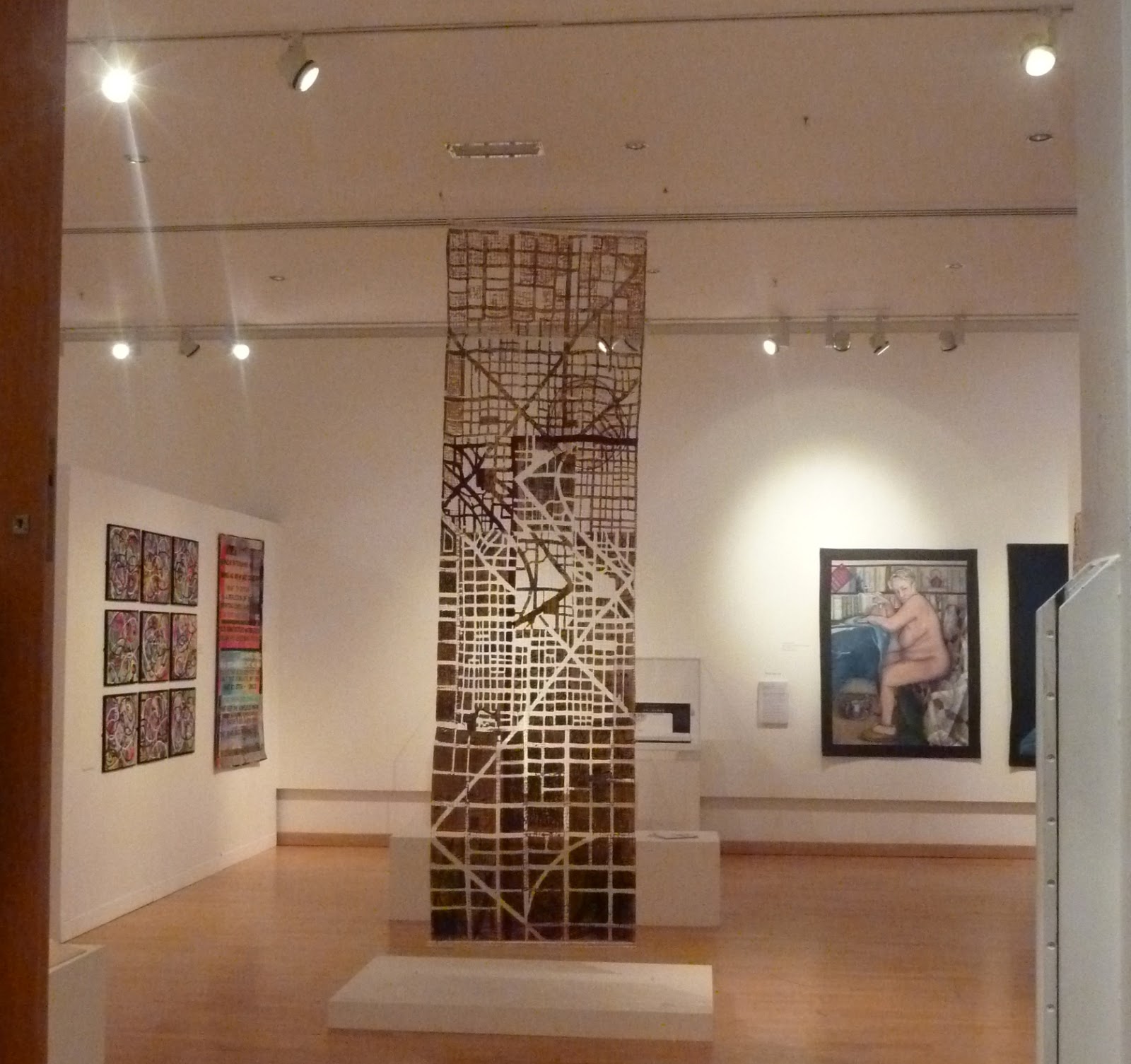
Eszter Bornemisza, City in the Aire  (Hungary)

'In my practice I try to work the unique characteristics of textile while striving to find ways to make my own statements. My starting points are ideas that reflect our relationships with traces and settlements of past cultures: the layers of existence. In recent years my interest turned towards large scale transparent textiles while keeping my sources of inspiration in patterns of urban living. Lately I have tried to expand the multi-layered networks of the cities into the form of three dimensional objects and installations'.