Tuesday, 10 February 2015

Impressionism at the National Gallery


Some of the Impressionist paintings we saw at the National Gallery during our recent 'Impressionist' day in London. 


Vincent Van Gogh, Two Crabs, 1889


Vincent Van Gogh, Farms near Auvers, 1890
 
A row of dilapidated farm buildings dominates this picture, made a month before the artist's death. Their shapes are mimicked by the fields and hills behind. The hasty brushwork and blank sky suggest that the painting is unfinished.


Vincent Van Gogh, A Wheatfield with Cypresses, 1889

Cypress trees reminded Van Gogh of Egyptian obelisks. These dark trees were in a wheatfield close to the St-Remy mental 'asylum' near Arles where the artist spent a year as a patient. They stand straight and tall in the middle of the wheat, and make a strong and deliberate contrast with the receding horizontal bands of the yellow field, blue hills and sky.


Akseli Gallen-Kallela, Lake Keitele, 1905


Theo Van Rysselberghe, Coastal Scene, 1892

This Belgian artist adopted the pointillist painting technique of Georges Seurat in the late a880s. In the following years he painted coastal and boating scenes characterised by a highly animated application of paint.


Paul Signac, Les Andelys, the Washerwomen, 1886


Camille Pissarro, The Cote des Boeufs at L'Hermitage, 1877


Pierre-Auguste Renoir, At the Theatre (La Premiere Sortie), 1878-7

A young girl and her chaperone are seated in a theatre box. They, not the stage, are the subject of the artist's and the audience's attention. The bright gold of the box emphasises their separation from the audience. It also makes a deliberate contrast with their blue dresses.


Edouard Vuillard, The Terrace at Vasouy, 1901


Berthe Morisot, Girl on a Divan, 1885

Morisot was always remarkably free in her distinctive handling of paint, the canvas animated here by vivid, quick touches of colour. The sitter was probably a paid model, but her frank and direct baze suggests a friendship between sitter and artist.


Pierre Auguste Renoir, The Skiff (La Yole), 1875

Rowing boats, boats under sail and steam trains crossing bridges were favourite motifs of the Impressionists when they painted sunlit summer scenes along the Seine in the suburbs to the west of Paris. Renoir combined all three in this painting.


Hilaire-Germain-Edgar Degas, Portrait of Elena Carafa, 1875


Hilaire-Germain-Edgar Degas, Head of a Woman, 1874


Hilaire-Germain-Edgar Degas, Combing the Hair (La Coiffure), 1896

The picture's unfinished appearance and striking orange-red colouration are characteristic of the artist's large-scale late paintings which influenced vanguard artists of the 20th century. Indeed, this picture was owned by Matisse.


Hilaire-Germain-Edgar Degas, Russian Dancers, 1899
 
The artist extended the composition by adding a strip of paper at the bottom.


Hilaire-Germain-Edgar Degas, After the Bath, Woman Drying Herself, 1890-5


George Bellow, Men of the Docks, 1912

Bellows arrived in New York in 1904 where he found rich subject matter in the lives of poor workers in the booming metropolis. Here, day labourers await jobs on the docks of Brooklyn on a grey winter morning. The towers of Lower Manhattan rise in the distance.


Sunday, 8 February 2015

The Bar at the Folies-Bergere


One of my favourite paintings - and we were able to see it again during our visit to the Courtauld two weeks ago.


Edouard Manet, A Bar at the Folies-Bergere, 1882

This was Manet's last major painting and a masterpiece, encapsulating his art and the painting of modern life.

Manet, like no other artist, painted the Paris that followed Hausmanisation, a brutal transformation of the city where the working class were displaced from the centre of the city and forced to live in the benlieux. 350,000 people were forced to move out of their homes and the city took on a new form full of boulevards, open spaces, parks, promenades, exhibition spaces and the cafes chantants - the city became a spectacle. The separation of public and private life followed. Free time - leisure - became a commodity like any other to be consumed not just by the bourgeoisie, but by everyone. The new available leisure activities meant that everyone could go out and take part in all of these activities, with the result that the distinctions between the classes became blurred, ambiguous.

The new city became the perfect place for the painter who trusted to appearances, to impressions. The truth of perception lay in staying on the surface of things and allowing ambiguity.

Manet gave form to this new city of appearances, of ambiguity and lack of intelligible form and nowhere else is this more apparent than in the Bar. This is a painting of surfaces and it is flat and it is about the masking of class relations.

Like all great paintings, this painting has a note of mystery. And like many of Manet's paintings, there is ambiguity and doubt.

Behind the young woman is a mirror and there is a very careful mismatching of the front and back views of the barmaid. What is in the mirror cannot be a reflection of what we see in front of it. Things are displaced - the barmaid's reflection is too far off to the right. Why is the mirror treated in this peculiar way? She faces us but the mirror shows her leaning towards a customer. Are we standing in his shoes?

There have been various explanations about this. T.J. Clark who devoted a whole, long chapter in his book The Painting of Modern Life to this painting, sees it as the reflection of the new social order during the advent of capitalism. A social order that is paradoxical, shifting, where things are not as they seem to be. This new age where leisure has become a commodity necessitates blurring of the social classes and a masking of their true relations. Displacing the reflection of the barmaid symbolises the displacement of social relations so that we are shown is not a repetition of what is there which is what a mirror is supposed to do. The gap between the woman and her reflection has a peculiar tension thus reflecting the gap between the social relations of the time and the way they were represented.

The woman's face is the face of fashion, which is the definition par excellence of modernity, as articulated by Baudelaire. Fashion is a good and necessary disguise, disguising identity and social class. Her expression is a mystery. What does it mean? Her face is totally unreadable. Philip Pullman notes that 'she is far more mysterious than that smirking Florentine we know as the Mona Lisa'.

And what about the acrobat's legs that dangle in the air in the top left corner? Another mystery.

To quote Philip Pullman again, this painting is 'about the mystery of that ordinary woman's unfathomable expression, it's about champagne and oranges and tobacco smoke and chandeliers and fashionable dress; but it's also about seeing, and about recording the way the light glistens on those
surfaces, and the way things in a mirror are different from things in front of our eyes; it's about the sensation of sight and the mysteries of representation; it's about painting itself'.


Sources:

T.J. Clark: The Painting of Modern Life (Paris in the Art of Manet and his Followers).

http://www.telegraph.co.uk/culture/art/art-features/8025267/Philip-Pullman-on-Manet-What-makes-a-masterpiece.html

Friday, 6 February 2015

Edouard Manet


We had an 'Impressionist' day in London two weeks ago, when we looked at paintings at the National Gallery and then moved on to the Courtauld.  I've decided to do some posts on specific artists as seen in both galleries, and will be posting them as and when.

                                                                       *   *   *

Manet was the painter of modern life par excellence.

Modernity in Paris was the result of Haussman's transformation of the city, following the brutal eviction of the working class from the centre. The result was wide boulevards, promenades, exhibition spaces and parks, which turned the city into a 'spectacle', a place to have outings, to see and to be seen. The city became an image. The distinction between private and public space got blurred and modernity took shape in the new public spaces where the bourgeoisie and the new petit bourgeoisie mingled. Leisure became a mass phenomenon and recreation took on increasingly spectacular forms: the parks, the races, the day out by the river, the café concert. It's this image that the Impressionists, and particularly Manet, set out to capture and present, and more specifically, they were fascinated by the people who used those open spaces.

The experience of 'seeing', rather than representing what one 'knew', took on paramount importance: 'I sought to render only my impression', said Manet. Wanting to give an impression of their subject matter, rather than representing it, coupled with their interest in colour and movement, they focused on the overall visual effect, ignoring detail. The picture plane became shallow, flattening out, almost two-dimensional: they abandoned the efforts of artists of previous generations, who had attempted to create the illusion of three-dimensional objects located in the two-dimensional space of the canvas. Flatness also signified modernity where the flat surface conjured up the two dimensions of posters, labels, fashion prints and photographs.

In his later years Manet abandoned his distinctive palette of blacks and greys and his art took on a new luminosity of colour and freer brushstrokes, influenced by Berthe Morisot. (Text taken from here )


At the National Gallery:


Corner of a Café-Concert, 1878-80

This work was originally the right half of a painting of the Brasserie de Reichstoffen in Paris, begun at about 1878 and cut in two by Manet before he completed it. A join where a new piece of canvas was added can be seen here in the man's blue smock. Manet subsequently repainted the background, adding the dancer, musicians and, on the left, a conductor's baton.


At the Courtauld:


Banks of the Seine at Argenteuil, 1874

This painting is probably Manet's deepest foray into open-air Impressionism. It was partly painted outdoors during a summer visit to Argenteuil on the outskirts of Paris, where he stayed with Claude Monet and his family. The latter's wife, Camille and son, Jean, posed for the figures on the riverbank. The rapid, short brushstrokes vividly evoke the ripples on the water and the bright colours convey the summer air.


Le Dejeuner sur L'Herbe, 1863-68
 
This is Manet's second version of a controversial composition he showed at an exhibition of works rejected by the official Paris Salon. It reworked the theme of a Renaissance painting he had seen in the Musee du Louvre, which represented female nudes listening to male musicians. Manet's painting was shocking because his pastoral idyll made deliberate references to contemporary life. The men wore modern clothing, and the naked woman was considered unattractive. As such, it seemed to mock academic 'high' art.
 
You can read more about this painting here .


Wednesday, 4 February 2015

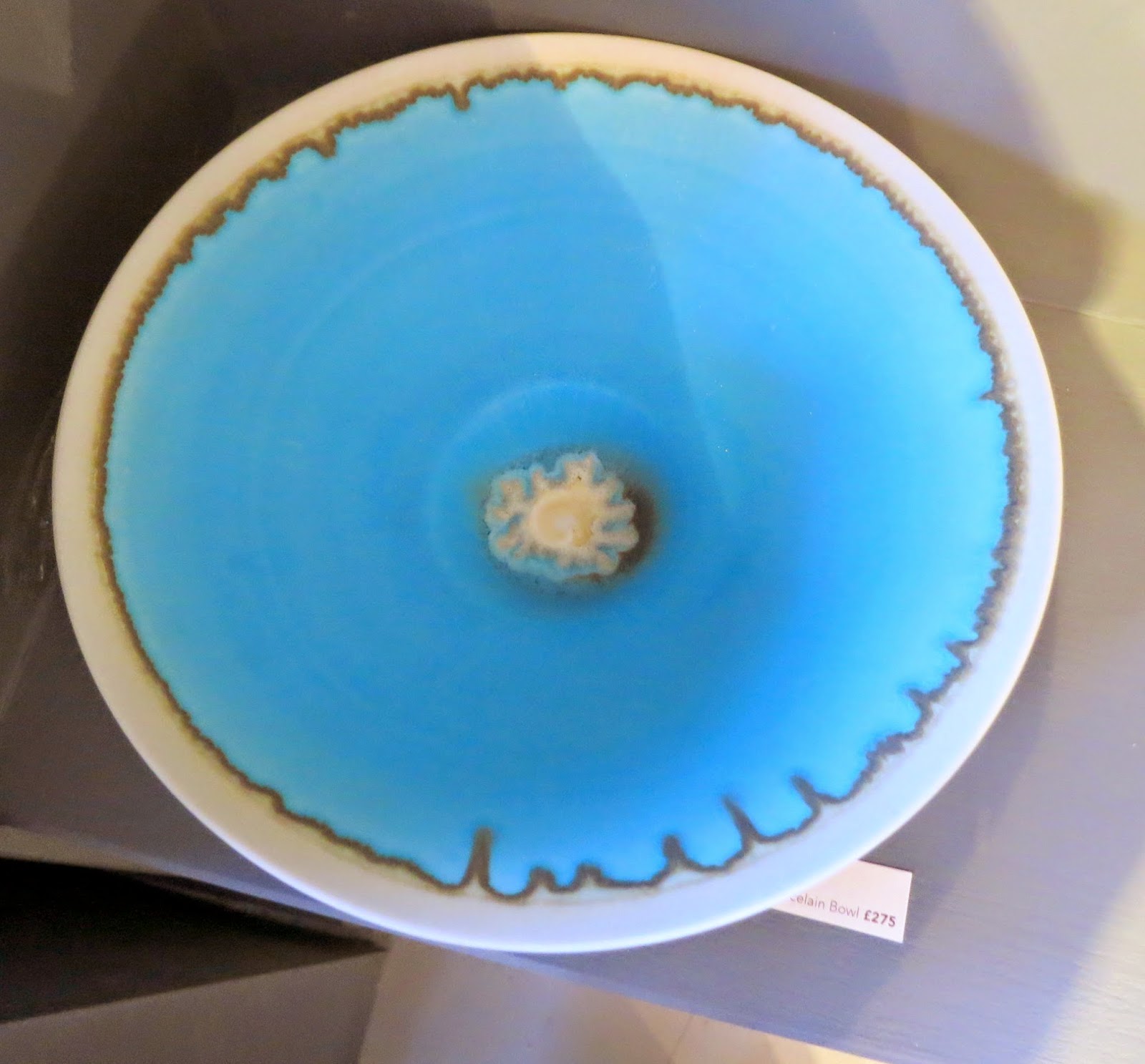
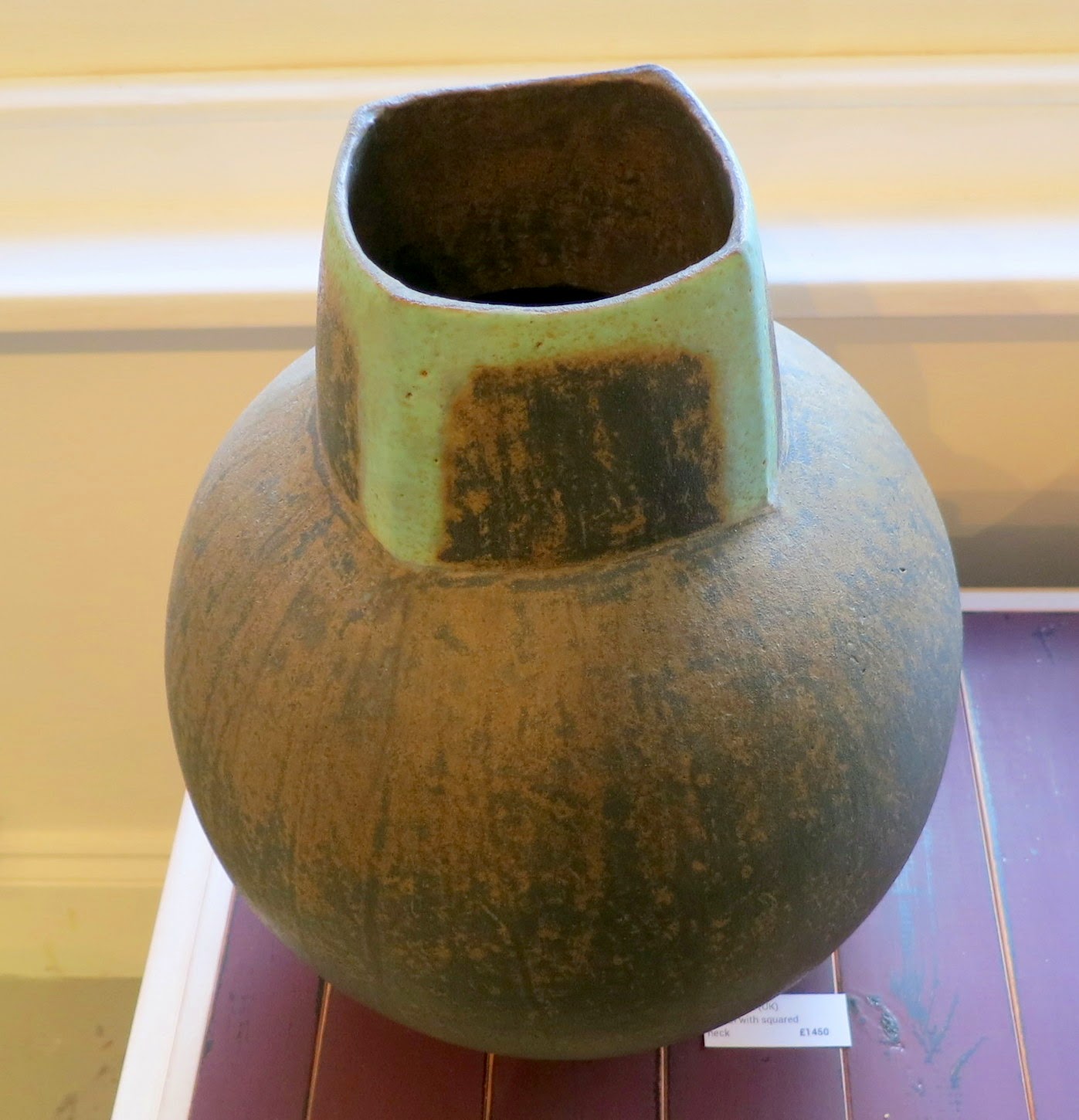
The Oxford Ceramics Gallery


The Oxford Ceramics Gallery, Walton Street, Oxford. 
 
Amazing selection of ceramics at the gallery this time, so much I really liked. Not so happy with my photographs though - too many shadows, but I still had to post some so as to remember....


Elspeth Owen

You can see more of Elspeth Owen's work here


Elspeth Owen 


Elspeth Owen


Elspeth Owen


Alan Wallwork


looking closer


Derek Wilson (dark celadon)


Peter Wills (porcelain) 


Peter Wills


Peter Wills


Peter Wills 
 
bowl


Peter Wills 
 
plate


Peter Wills 


Peter Wills 


Derek Wilson (pale celadon) 


Duncan Ross 


John Ward 
 
You can see more of John Ward's ceramics here


Anne Floche 


Jack Doherty (soda fired) 


Jack Doherty. 


Monday, 2 February 2015

Rembrandt


Rembrandt - the Late Works, at the National Gallery,


Trafalgar Square.

We went to see this exhibition on its penultimate day at 2:00 in the afternoon. A recipe for disaster? Definitely. The crowds were horrendous, not just in front of the paintings, but throughout the rooms - you had to keep excusing yourself in order to move even an inch. Do I regret it? Absolutely not as it was fabulous. But, we gave up on looking at the drawings early on as we could not get anywhere near them, and concentrated on the paintings instead. It was still worth it and I am so glad we did see this once-in-a-lifetime exhibition.

This exhibition is dedicated to the last twenty years of Rembrandt's life which were extremely difficult: the bankruptcy from which he would never recover; falling out of artistic favour; the death of his common-law wife; the death of his only son Titus. These were also the years when he produced his best work.

According to the booklet provided for the exhibition 'it is [Rembrandt's] late works that define our image of him both as a man and as an artist. Far from becoming complacent as he aged, or falling into artistic decline, he radically changed course in his later years to create many of his most daring drawings, prints and paintings. He embraced new challenges even as he suffered reversals of fortune, and personal tragedies that included the deaths of his son and common-law wife.

The works exhibited... reveal a relentlessly experimental approach to technique, an extraordinary skill in rendering the effects of light, an appreciation for mundane or even ugly subjects, an avid plundering of diverse visual sources for creative inspiration and a quest to understand and represent humanity's deepest motivations and emotional states'.

I found it very difficult writing up this post as my emotional response to the exhibition was very strong and I still have not managed to sort all of my ideas out. I would definitely recommend Simon Schama's video on the exhibition, as well as the articles he has written on the subject: you can read one of them here .


Self Portrait, 1659

The exhibition began with five self-portraits which chronicle Rembrandt's ageing over the last decade of his life. These are not documents of his appearance: they are about the inner person, a process of self-scrutiny, that reveal the soul and which question what it is to exist.

Unlike many of the old masters, who wrote down their observations, or exchanged ideas with other leading scholars, Rembrandt did none of these things. Yet we feel we know him more intimately and this is because of the series of self portraits which span the whole of his life, from when he was a young man to his lonely old age when his face reflected the tragedy of bankruptcy and the unbroken will of a great artist. In his self portraits he observed himself with sincerity and what we see is the face of a real human being: there is no trace of a pose, or vanity. It's the face of a person who wants to know about life, what it means being a complex human being who has experienced love, warmth, loneliness and suffering. They are magnetic and draw you in.


Self Portrait as the Apostle Paul, 1661

This is my favourite of the self portraits, full of pride beneath all the suffering he experienced in his last years and so much vulnerability too. A narrow shaft of light draws attention to the figure's head, and may also suggest spiritual enlightenment.


Self Portrait, 1669


The Conspiracy of the Batavians under Claudius Civilis, (1661-2)

Hidden by the figures in the foreground, a single lamp lights the scene, turning the tabletop into gold and eerily illuminating the conspirators with reflected light.


Self Portrait with Two Circles, (1665-69)

The enigmatic circles in the background probably refer to the traditional claim that the ability to draw a perfect circle freehand was the ultimate proof of an artist's skill.


Lucretia, (1666)

Simon Scharma on this painting: 'There has never been a Lucretia like this, her face shiny and pallid with death, a painting of slits and gashes and apertures, where the torn, punctured body of the woman is made utterly naked by being ostensibly covered. The powerless belt slung across her hips has... become a slung sash extending from her right shoulder down to the left side of her waist and so travelling across the sites of her violation. It fixes our gaze, first on the deep V-shaped opening of her shirt and then on the terrible, spreading, soaking bloodstain that extends from her heart down toward her thighs. There is nothing like this bloodstain in all the countless martyrdoms of baroque painting, in all of the spurting severed heads and severed breasts; nothing that pulses quietly and fatally out of an unseen wound. Rembrandt has even made the folds of Lucretia's shift hang forward on either side of the wound, while between them, in a saturated depression, as if rehearsing the site of her rape, the blood-soaked fabric clings wetly to her skin...

Her pathos is of resignation. She has opened herself bodily, to the possibility of mercy. Faultless, she has nonetheless sinned; spotless, she has become stained. But she hangs on to the cord, life ebbing away from her, awaiting the embrace of compassion, the reception of grace'.


The Anatomy Lesson of Dr Joan Deyman, (1656)


Juno (1662-65)


Portrait of a Lady with an Ostrich-Feather Fan, (1656-8)


The Sampling Officials of the Amsterdam Drapers' Guild, known as the Syndics,  (1662)


Portrait of Jacob Trip, (1661)


Portrait of Margaretha de Geer, Wife of Jacob Trip, (1661)


Titus at his Desk, (1655)


An Old Woman Reading (1655)
 
The woman is seen extremely close at hand. Her cloaked body fills the entire width of the picture; her hands and her massive book seem to project from the canvas. Shrouded beneath a dark hood, the woman's face is illuminated by light reflected upwards from the open pages. By drawing the viewer so close to his subject, Rembrandt invites intimate access to the woman's innermost thoughts.
 
She is totally absorbed in the act of reading - there is complete concentration here. This painting is the act of reading itself.


Portrait of a Couple as Isaac and Rebecca, known as 'The Jewish Bride', (1665)
 
A painting about intimacy, and we become witnesses to the emotion between the two.  'I would gladly give up 10 years of my life to sit in front of the painting for a fortnight, with only a dry crust of bread to eat', was Van Gogh's rather melodramatic response to this painting.


A Woman Bathing in a Stream (1654)
 
The first impression of Rembrandt's paintings is that of a rather dark brown. These dark tones give even more power and force to the contrast of a few bright and brilliant colours so that the light on some of his paintings looks almost dazzling. These effects of light and shade enhance the drama of the scene.


Titus in a Monk's Habit, (1660)
 
As always with Rembrandt, this is not a description of the sitter's physical appearance, but of their interior life, their thoughts and feelings. The brown monk's habit and cowl isolate Titu's face, making it the focus of the picture's visual interest. The imperceptible smile on his lips, as in the Mona Lisa, makes the picture mysterious.


Lucretia, (1664)
 
Simon Scharma on this painting: 'The artist has made something crushingly weighty of the costume, building the paint until it is as solid and impenetrable as the ironclad armour of the heroine's virtue. Yet it is an armour that has been pierced. The deep green impasto... is worked and layered in the lower part of the painting where Lucretia's skirt is vainly girdled by a belt that circles her body just below the waist. But all this heavy casing of the paint layer is calculated to make the sense of the soft vulnerability of the body within - not just in painfully delicate exposure of the flesh at her throat and between her breasts, but in the fore-shortened left forearm at her opened sleeve - even more poignant. The fastening of her bodice have been loosed and hang freely down to her waist. A teardrop pearl, the insignia of her virtue, is suspended just above the site where the dagger will rend the flimsy veil of her shift and into her heart. But her eyes are red with tears already shed, others gathering and brimming; her upper lip moist with misery...Lucretia holds up her left hand, both in affirmation of her innocence and also to still the protests of the horrified household'.
 
 
Source: