Museum of Contemporary Art (EMST) in Athens, new acquisitions.
Even though the museum is not fully operational yet - they say it will take at least another year - there is an exhibition of some of their new acquisitions at the moment, and last week we went to have a look.
The museum was full of school groups when we visited. This year 1 group were delightful: interested, engaged and beautifully behaved.
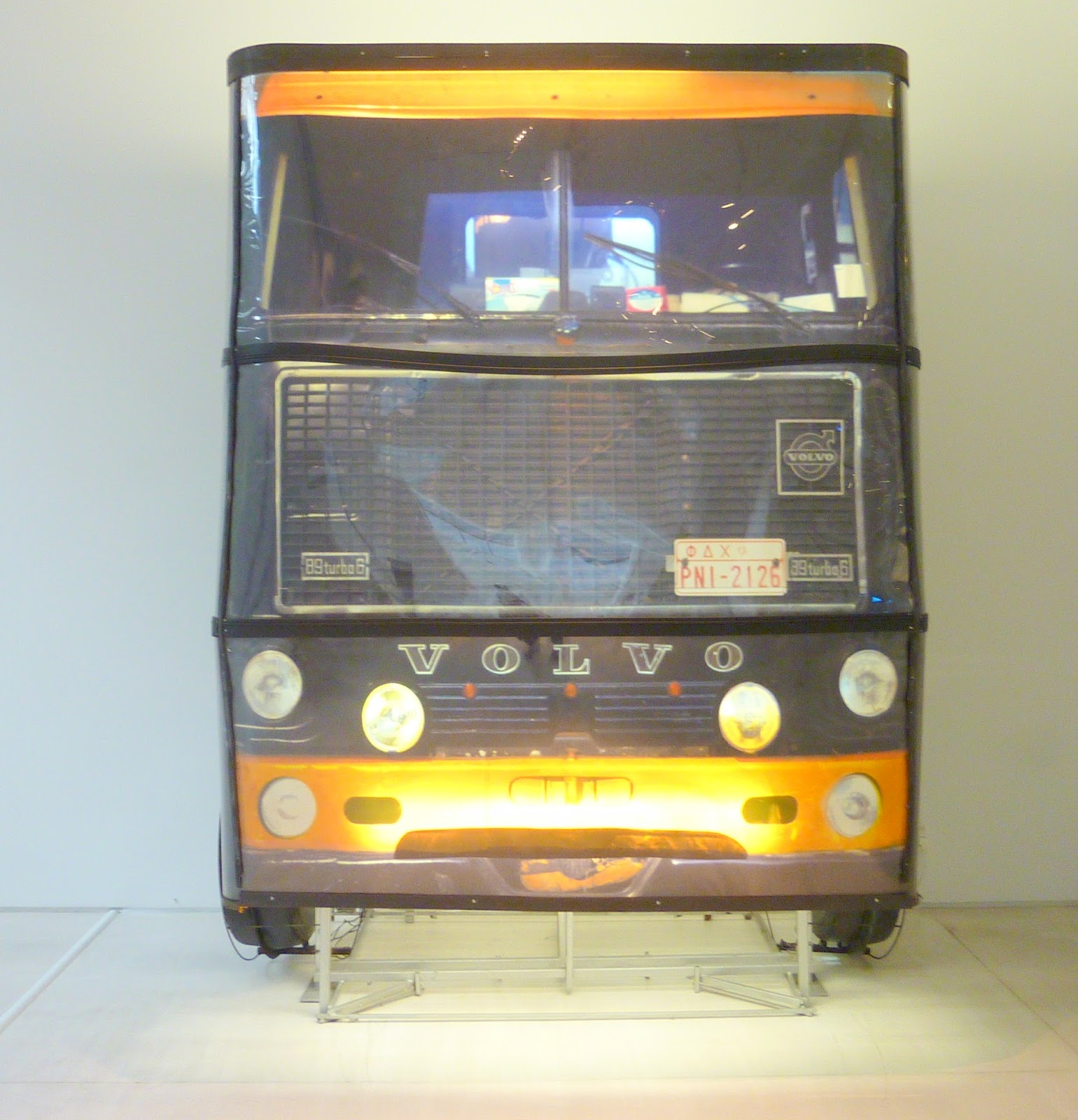
George Lappas, Truck, 2001, (photographic membrane, PVC, iron, neon lights)
Piotr Kowalski, Perspective Dhuison, 1970-1997, (photography on canvas with blue neon)
Lizzie Calligas, Untitled (from the Swimmers
series), 1997, (silver print mounted on aluminium)
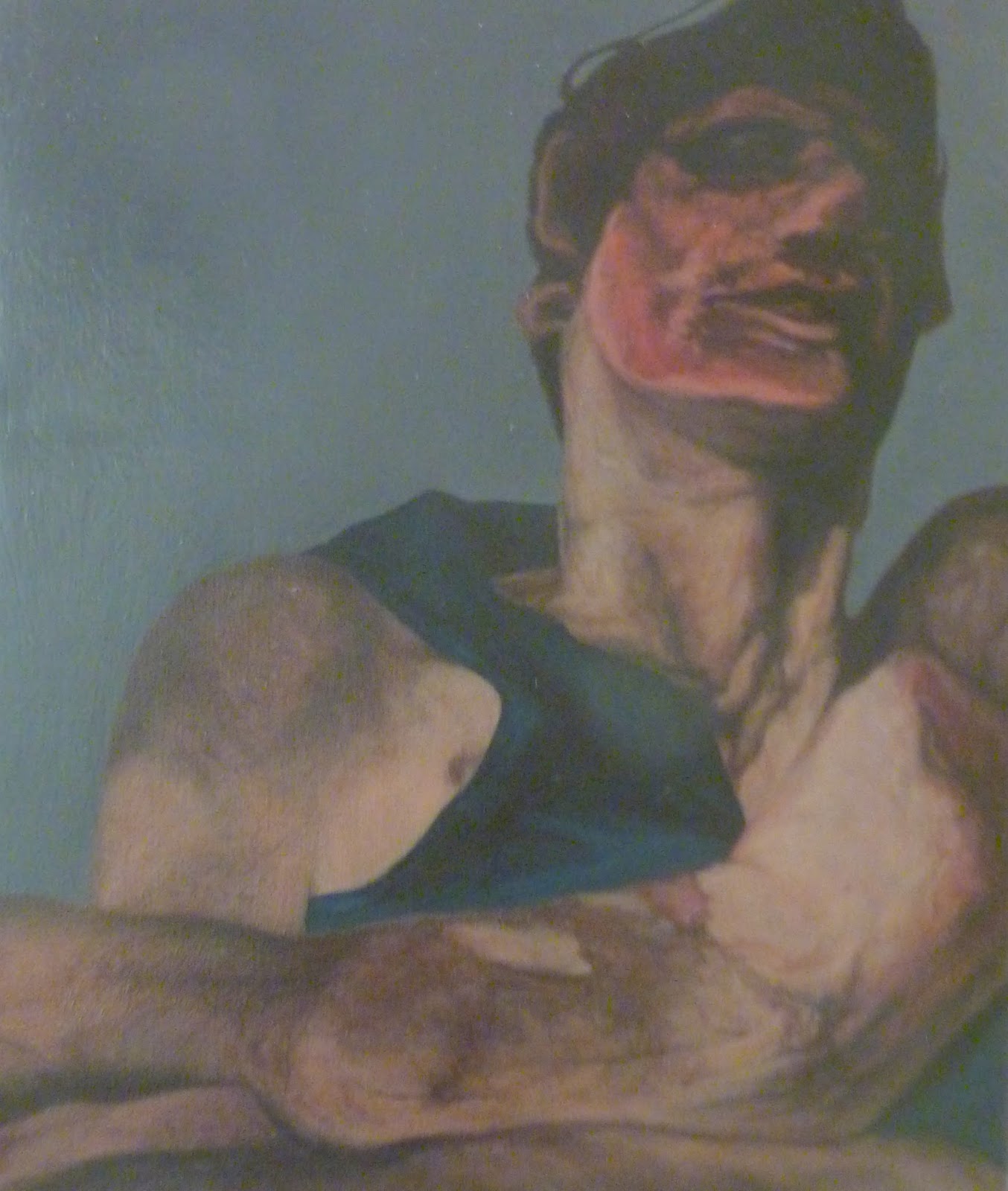
Stathis Logothetis, E273, 1970, (oil on canvas)
E273 was part of a performance where the artist sat on the chair and covered his body with the cloth leaving out only his head.
Pandelis Chandris, Shadow Cliffs and Eight Ecliptic Full Moons, 2016-2017, (black silk paper, prints on white paper, bamboo covered with silk paper, epoxy mastic)
looking closer
and a group photograph
Ilias Papailiakis, The Portrait of P.P. Pasolini, 2015, (oil on canvas)
Santiago Sierra, 250cm line Tattooed on 6 paid people, Espacio Aglutinador, Havana, Cuba, 1999, (lambda print on dibond)
Sierra's work addresses the hierarchies of power and class that operate in our society. Sierra became known for his actions in which underprivileged or marginalised individuals were hired to perform pointless tasks in exchange for money. He has carried out provocative actions around the world underlining labourers' exploitation, isolation and repression within capitalist structures. For this work, six unemployed young men from Old Havana were 'hired' for $30 in exchange for being tattooed.
Eugenia Apostolou, Disembodiment, 2012, (oil on canvas)
Jannis Kounellis, Untitled, 1967, (steel, wood, paraffin lamp)

Nikos Tranos, A Glacier at our Table, 2013, (glazed clay, wooden table)
This sculpture refers to the idea of the nuclear winter, i.e. the climate conditions expected to prevail on the planet in the case of an extended nuclear war. The bright pink mutant forms are made in the colour of the hospital section where the victims of radiation poisoning were treated after the nuclear disaster at the Daiichi power plant in Fukushima. Despite the fairytale image it presents at first glance, the work comments on our complacency.
looking closer
Joanna Hadjithomas and Khalil Joreige, I Stared at Beauty so Much, 2013, Waiting for the Barbarians, (animated photographs, video, sound, HD format)

The video is a synthesis of about 50 photos of panoramic views of Beirut. The representation of the city hovers between the movement and the static, the detail and the general picture. Focusing on C.P. Cavafy's poem
Waiting for the Barbarians, which is heard throughout the video, the two artists from Lebanon connect the era in which the poet lived in Egypt with the contemporary fluid socio-political conditions in the Middle East, at a time, when, as it is noted,
'eternity has never been so precarious'.
Andreas Lolis, Shelter, 2013-16, (marble)
Dimitris Tzamouranis, 38o36'N - 25o78'E, 2017 (oil on canvas)
The work is part of a seascape series in which the artist depicts the spots in the Mediterranean where refugees' boats have sunk. Starting from his home town in Kalamata, Tzamouranis visited these locations seeking an experiential relationship. Then, with the help of photos and drawings, he attempted to convey on his canvas the whole of the human tragedy through the image of the black, stormy sea, ready to engulf every trace of human life. In the works' titles he gives the exact coordinates of the wrecks.
looking closer
Alexandros Psychoulis, Monument for the Things That Change, 2014, (plastic cord, metal frame)
This work focuses on the 'Greek language issue' and more specifically, on the so-called 'atheist' trial, the trial of Alexandros Delmouzos, head teacher of the Volos School for Girls in Nafplion in 1914. Delmouzos was accused of spreading atheism and moral corruption because he was using pioneering teaching methods where the Demotic (colloquial) language was used. Reactions from the clergy and conservative members led to a trial.
Costas Varotsos, Untitled, 2017, (digital print on glass)
The installation consists of the flags of the 27 countries, members of the European Union. Having created the glass floor map, the artist then broke it - a comment on the differences that divide today's Europe, as well as on the displacement of people from one country to another.
You can see more of Varotsos' work
here and
here
looking closer.
Bertille Bak, Rayonnage, installation, 2009-2014, (wool on canvas, iron structure, six needlepoints)
Nikos Alexiou, Shady Water, 2001, (reed, string, cannabis, cotton fabric)
Ziad Antar, WA, 2004, video
We had great fun watching this delightful video of the two children singing Waaa
Chrysa, Untitled, (aluminium, red colour, neon)