Saturday, 17 September 2011

By the gas works....

Very few of the old neo-classical buildings remain in Athens having been demolished and substituted by apartment blocks, a lot of them pretty ugly. In the last few years however some stylish, elegant and imaginative apartment blocks have started going up, and this is one of them.


It is in Gazi, on the square,


next to the gasometer.


I have taken a series of shots, moving from left to right.


It is not finished yet. People have moved into the apartments, but the ground floor is still a building site - it looks like it will be a shop.


I normally like simple, clean lines, and even though the lines here are clean, it is certainly not a simple design.  But I love it.


I love the geometry of it, the black against the white, the panels that divide each section. It looks like a piece of sculpture to me.


Some of the balconies are huge, and some are very cosy. The sitting rooms that open into each balcony have all glass walls - the views from there must be fantastic, not just the Acropolis and surrounding monuments, but also Lycavettus.


Wednesday, 14 September 2011

The George Economou collection - 2

At the Athens Municipal Gallery in Mataxourgeio again, for the second time this year, to see the second part of the George Economou Collection - for first part see this blog, February 24.


George Economou, a shipping magnate, has been building an art collection for the last ten years, buying at the rate of 200 a year and at the last count he had 2,500 works of art. He buys what he likes, they don't have to be masterpieces by universally recognised names. In 2007 he bought the Bridget Riley shown below, one of her largest paintings for 1,640,000 euros, the highest  price ever paid for a work of art in Germany. On the other hand he paid £21,000 for a drawing made by Lucien Freud on a letter to a friend (pictured on 24 Feb in this blog).  Similarly, the Picassos are all drawings, bought so as to show what a brilliant draughtsperson he was.


This second part of the exhibition focuses on Surrealism, the Paris School, Art of the first part of the post-war decade, the 1960's, the Neo-Fauves and portrait-nude-still lives (1890-1961).


Paul Delvaux, The Vestals, 1972


Paul Delvaux, The Visitors of Mycenae, 1959


Eduardo, Naranja, The Ruined Times of Isadora, 1977


William Baziotes, Untitled, 1940


Rene Magritte, The Discovery of Fire, 1959


Albert Reuss, The Blue Shoes, 1948


Man Ray, The Mountain Cristal, 1950


Mikhail, Larionov, Still Life with Pears, 1930


Natalia Gontcharova, Among the Big Trees, 1916


Moise Kisling, In Front of the Window, 1925


Francois Gall, Woman at the Mirror


Leonard Foujita, Milk Seller, 1965


Thanos Tsigkos, Abstract Construction


Andy Warhol, Portrait of Wayne Grentzky, 1983


Maria Lassnig, Remembrance of Buddy Frieberger, 1954


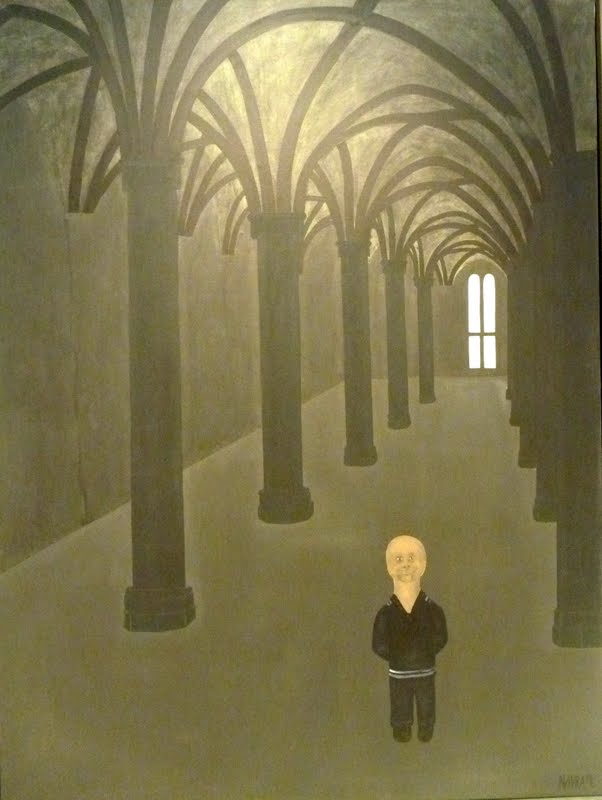
Walter Navratil, Cathedral


Antonio Recalcati, Preface


Bridget Riley, Byzantium, 1969


Anselm Kiefer, For Paul Celan, 1989


Stephen Mackenna, The Falling Woman,  1970-71


Cataldo Crescende, At the Time Circle of Life, 1990-92, (acrylic on plexiglas)


Karl Hofer, Madame at the Table, 1933


Pablo Picasso, Portrait of Martin Fabiani II, 1943


Francois Picabia, Portrait of Pablo Picasso, 1920-25


Hans Boltz, Portrait of  Alfred Flechtheim, 1910-11


Joan Miro, King Ubu, 1966


Henri Laurens, Dialogues, 1951


Alberto Giacometti, Paris sans fin, 1957-62


Max Ackerman, Two Female Nudes Outdoors


Jean Metzinger,  Bather, 1937


Rodolphe-Theophile Bosshard, Naked Woman 


Tamara de Lempicka, Succulent Plant and Flask, 1941


Pictured here, six of the 12 exhibited etchings of David Hockney's illustration of C.P. Cavafy's poems


David Hockney, Cavafy in Alexandria, 1966


David Hockney, In Despair, 1923,  Illustration for the Poems by C.P. Cavafy, 1966


David Hockney, In the Dull Village, 1925, Illustration for the poems of C.P.  Cavafy, 1966


David Hockney, Two Boys, Aged 23 or 24, 1927, Illustration for the poems of C.P. Cavafy, 1966.


Friday, 9 September 2011

Aesop's fables, by Manolis Haros


I had a real trip down memory lane last night following the opening of Manolis Haros' exhibition which was inspired by Aesop's fables, and straight away I was back at primary school in Kalamaki. I had not read or thought about Aesop's fables since that time but during the exhibition it all came flooding back and with it, images of my childhood.


The Fox and the Grapes.

I am six years old and I am sitting on our back terrace. Our terrace that time was huge, and we lived on it during the summer: my mother would even do all the food preparation there before going into the kitchen to use the hob or the oven. I had a swing suspended from the rafters of the pergola which was covered with vines -  a great source of shade. I am looking at the grapes hanging over my head and I am thinking about the poor fox that could not reach the juicy grapes. The fact that the fox walked away muttering to himself  "I am sure they are sour"  was hilarious, I thought.


The Moon.

The moon once begged her mother to make her a gown. "How can I?", replied she; "there's no fitting your figure. At one time you're a New Moon,  and at another you're a Full Moon; and between whiles you're neither one nor the other".

How cruel life can be, and learning it at such an early age!


The Fox and the Stork. (This painting reminded me of a series of paintings I saw by Louise Bourgeois at this same museum last year).

One bad turn deserves another - I was never sure about that but I remember being around seven this time. The fox invited a stork to have some soup, and served it in a shallow dish which made it impossible for the stork to eat - I could almost hear the stork's  bill scraping the bowl. The next day the stork got its revenge, and invited the fox to have soup served in a long-necked jar with a narrow mouth, which made it impossible for the fox to eat. I kept trying to picture that.... and was fascinated by it.


The Two Pots.


The Cast Iron Pot.


The Old Man and Death.


The Old Man and Death.

An old man, bent down with old age and toil,  was gathering sticks in a forest. At last he grew so tired and hopeless that he threw down the bundle of sticks, and cried out:
"I cannot bear this life any longer. Death come and take me".
As he spoke, Death appeared and said to him: "What do you want old man? I heard you call me".
"Please sir", replied the old man, "would you kindly help me lift this bundle of sticks on to my shoulder?"


The idea of  'be careful of what you wish for' used to intrigue me even though I could not quite grasp the complexity of the idea. More than that was the idea of death itself, which in my mind's eye was coloured by all the pictures of the grim reaper with his scythe that I had seen endless times in picture books - just like the picture above, in fact.