Thursday, 26 November 2015

The Sage


The Sage, Gateshead.

Designed by Norman Foster, the Sage has been open since 2004. It's one of the biggest performing arts venues in the North. It was designed as three separate halls which do not touch, leaving gaps between the walls and ceilings for additional acoustic circulation. Foster then designed a canopy to fit over the top of all the individual rooms and the concourse level, resulting in the unusual shell or cloud shape that can be seen from the outside.

The image above is the view from across the Tyne.


The main entrance


The back entrance, or entrance from the car park


The back of the building


The concourse is always very busy, with people either wandering around or using the café/restaurant


and provides excellent views of the river and Newcastle


the bar area on the first floor


The coloured glass balustrade that runs the length of the concourse was designed by Kate Maestri


The staircase and its elegant lines


Interesting lighting enhances the architecture of the space when it gets dark.


Tuesday, 24 November 2015

Quayside


Seven bridges across the Tyne link Newcastle and Gateshead. The area around the Millenium and the Tyne bridges is known as Quayside and was once industrial with a busy commercial dockside but nowadays it has been heavily redeveloped. The Gateshead side is sign-posted Gateshead Quays, and is the site for the Baltic Centre for Contemporary Arts and the Sage, a music venue. The Newcastle side is full of restaurants, bars, night clubs and modern housing.


The Gateshead Millennium Bridge dominates the area. It opened in 2001, was designed by Wilkinson Eyre and is a pedestrian and cyclist tilt bridge.


We started from Gateshead


and crossed over


to the Newcastle side.


From the bridge we had a good view of the Sage


and of the Baltic.


It was a very pleasant walk


affording good views of the bridge


and of the Baltic across the water.


We reached the Swirle Pavilion designed by Raf Fulcher.


It has the names of various cities carved on the inside, taken from a faded sign that advertised the major destinations of the Tyne-Tees Steam Shipping Company from Newcastle in the 19th century.


A bit further on we reached the Blacksmith's Needle designed and made by artists of the British Blacksmiths Association. It has six section: each section contains objects which relate to one of the senses, including the 'mysterious sixth'.


It was a short walk


but bracing as it was cold and windy.


We reached the point where the Ouseburn joins the Tyne. On the far side of the Ouseburn stood the River Police Station and the Dead House, where bodies found in the Tyne were laid out for identification. These buildings were demolished in 1906.


On the walk back we could see the Millennium bridge and arched below it, the Tyne bridge.


Following our walk we went to see the exhibitions at the Baltic and then had lunch at the Sage. It was starting to get dark by the time we had finished and Millennium bridge was lit up


It must look wonderful when it's dark.


Sunday, 22 November 2015

Hannah Collins

 
'Most of my work is a line between culture and the world'. Hannah Collins.


Hannah Collins, at the Baltic, Gateshead.
 
Collins first became known for the giant, unframed black and white prints on canvas made in her Hackney studio in the 1980s and these were the subject of the exhibition at the Baltic. Collins is interested in revealing the history of urban space, exploring notions of loss, time and transformation.
'The most important thing for me is that my work develops deep links with the environment in which it is made'.
 
She is interested in survival and  documenting places created by those who have been displaced. She is attracted to marginal places occupied by those who exist on the borders of society.
 
'I'm always trying to measure the work in relation to the viewer and make the viewer work in looking at it. So the title is important and it gives you a way in, but it is not entirely revealing. It gives you certain elements of the work'.


Thin Protective Coverings, 1986.

In her Hackney studio she created what appears to be an empty stage set, backed with draped plastic and lined with flattened cardboard boxes. The image appears to continue the floor and wall of any space in which it is hung. The image evokes the makeshift environment of the homeless and the displaced - transitory and disposable, cardboard is the mainstay of surviving life on the streets.

The reference to 'coverings' also suggests skin, our own thin protective covering.


Family, 1988
 
A set of speakers stacked and arranged to resemble a family group.


Grapes, 1989


Signs of Life, Gypsies, 1992

A detailed image of the old city walls of Istanbul where migrants appear to sleep amongst the ruins of previous cultures.


The Road to Mvezo. Reading - Umtata, Mandela's Teenage Home, National Monument 2007-08.
 
Collins visited Mandela's birthplace in Mvezo and was taken to a hut that was Nelson Mandela's home as a teenager. 'There was something about the nature of the hut. First of all, it was like a history painting... I was thinking how do you recount history, and what is the impact of a place or action? The image is a wall with books on the shelves. The books look as though someone put them there recently. There is a pair of recently left underpants. There are things in the image that have nothing to do with what it says it is, but it is that thing. This picture is about the recounting of things'.


Source:

http://www.studiointernational.com/index.php/hannah-collins-interview-camden-arts-centre-noah-purifoy

Friday, 20 November 2015

The Baltic


The Baltic Centre for Contemporary Art, Gateshead.


The building is a converted flour mill. The mill was built for the Rank Hovis company to a late-1030s design by architects Gelder and Kitchen and was completed in 1950. It closed in 1981. Dominic Williams converted the building into an arts centre and it opened to the public at midnight on Saturday 13 July 2002.


The centre stages temporary exhibitions. There are only two permanent exhibits, and the one above, is one of them. It's Blake in Gateshead (1966) by Jaume Plensa.

The artists' statement: 'Walking near the Tyne and thinking of Blake, I thought a new bridge was needed, a vertical bridge to bring us towards another kind of landscape. That landscape is above our heads and underneath our feet and maybe because it is too close or too far it is unattainable'.


We visited the library


And then we went up to the fifth floor, where we could look down to the fourth floor where the next exhibition which is opening on the 20th of November, was being set up.


Bill Murray: a story of Distance, Size and Sincerity by Brian Griffiths
 
The artist's statement: Bill Murray is always authentic. He is consistently Bill Murray. His singularity breaks into irreducible ambiguities and contradictions - Bill the global superstar, the guy-next-door, anti-brand brand, irrepressible lothario, dignified clown and droll philosopher. This exhibition will take these and many other characteristics as an approach, turning them into a fantasy caricatures and a poetic tableau of scaled down architecture and collections.


The artist setting the exhibition up


We then moved on to the viewing platform: the Tyne, Gateshead and Newcastle were in front of us


an excellent view of the Millennium bridge


as well as The Sage.


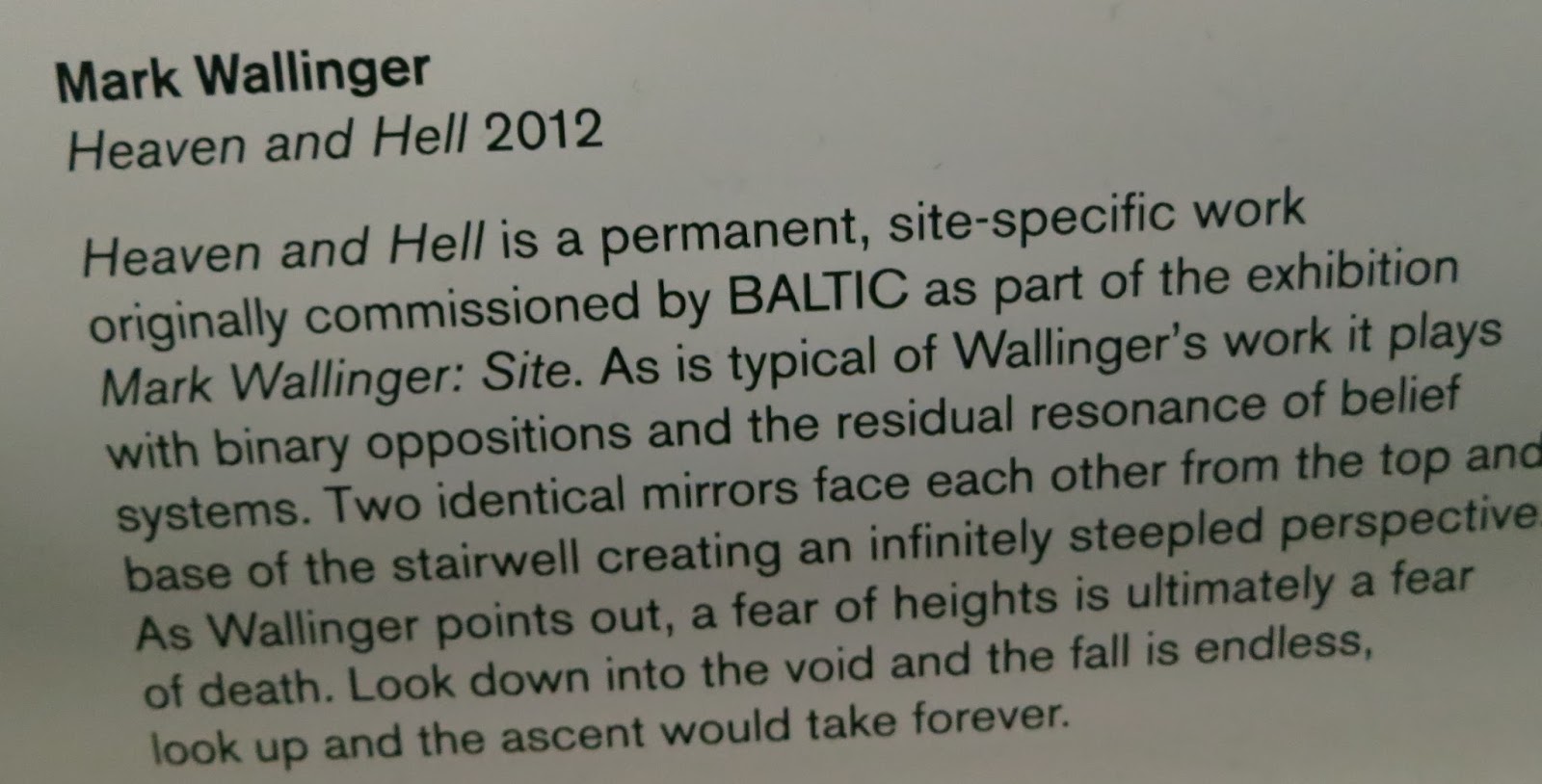
We then had a look at the second permanent exhibit of the Baltic. Heaven and Hell (2012) by Mark Wallinger

Two identical mirrors face each other from the top and base of the stairwell creating an infinitely steepled perspective. As Wallinger points out, a fear of heights is ultimately a fear of death. Look down into the void and the fall is endless, look up and the ascent would take forever.

The photograph above is looking down


and this photograph is looking above.

The photographs do not convey the feeling of vertigo that was induced.


Wednesday, 18 November 2015

Lumiere in Durham

Originally planned as a one-off, Lumiere has grown into the UK's largest light festival. We saw only a fraction of it, but what we did see was spectacular. The city was very dark, all the better to see the light shows, but this meant that a lot of the photographs I took did not come out well at all.
 
 
The World Machine:


The story of the birth of modern cosmology from the 12th century until the present was told on the façade of Durham Cathedral.


It was son et lumiere, and the sound was very impressive too


The Big Bang, black holes, medieval cosmology, dark holes, the formation of galaxies,  all figured in the light projections on the cathedral


Some of the projections were necessarily too dark, and even though I snapped, the photographs did not come out well


so I am not able to show each section as it unfolded


but here are some of the brighter photographs to show how spectacular it all was


Garden of Light:


The French team behind this installation created 'giant illuminated plants to bring tropical summer to wintry November'


at the College, behind the Cathedral


it was a pleasure walking around


There were more of these plants along South Bailey


and the Prebends Bridge


The darkness of the city streets enhanced the experience


We moved down to the river and got a different view of the illuminated cathedral.


Les Lumineoles:


Lit by LEDs the brightly lit imaginary birds twisted and turned against the wind in Market Place


Fogscape:


Japanese artist Fujiko Nakaya was the first artist to use fog as a sculptural medium, using it for transmission of light and shadow. We saw this as we stood on Framwelgate bridge


Fool's Paradise:


From Framwelgate bridge we also had the opportunity to see Fool's Paradise projected on Durham castle.

Tales of local history, folklore and famous fables were projected, using elements of stopmotion animation, paper cutting and hand drawn images.


The Pied Piper in this image.


Asalto Durham:


Durham residents appearing to be climbing the viaduct, eventually reaching the top. Artist Daniel Canogar says that his installation is 'a large-scale projection that helps us imagine overcoming the obstacles in our lives'.