Showing posts with label Cathedrals. Show all posts

Wednesday, 3 June 2015

Stockholm Cathedral


Built on the highest point of Stadsholmen island, Svenska Kyrkan, Stockholm Cathedral, dates back to the middle of the 13th century. Major conversions and extensions took place in the 14th and 15th centuries, but there are still some parts that date back to 1306.


The exterior was rebuilt on 1736-42 in Italian Baroque style to be a more appropriate complement to the Royal Palace, which had also been recently rebuilt.


The back of the cathedral.


It's a very impressive building.


The Silver Altar is made of ebony and silver.


looking closer


The sculptural ensemble of St George and the Dragon is carved out of oak with details made of materials such as elk antlers and horsehair.


There are two royal pews used exclusively by members of the royal family when attending official ceremonies in the cathedral. The pews were designed by Nicodemus Tessin the Younger in 1684 and were carved out of wood.


The Pulpit dates back to 1700 and is as sumptuous and extravagant as the royal pews.


The organ was built in 1960 and has 53 stops.


The seven-branched candlestick is 3.7 metres high, made out of bronze. It has stood in the Cathedral for more than 600 years.


I could not find any information on this modernist religious painting.


The Crucifixion was created by David Klocker von Ehrenstahl in 1697.


Detail of the ceiling


The Parhelion painting depicts a light phenomenon that occurred over Stockholm on 20 April 1535. Six sparkling luminous rings of light, parhelia (sun dogs, or mock suns) were observed.  They were interpreted to be a revelation of the impending collapse of worldly power, and people flocked to the churches.


A clearer depiction of the phenomenon.


The candle globe has been in the cathedral since 1972 and is the work of Torolf Enstrom.


I could not get any information about this stunning stained glass window.


Monday, 16 March 2015

Winchester Cathedral


Winchester Cathedral
 
One of the largest cathedrals in England, with the longest nave and greatest overall length of any Gothic cathedral in Europe, Winchester Cathedral was founded in 642 on a site immediately to the north of the present one. This building became known as the Old Minster and it became part of a monastic settlement in 971.


In 1079 work began on a completely new cathedral. A substantial amount of the fabric of the old building, including the crypt, transepts and the basic structure of the nave, survives. Numerous additions and restoration have been carried out since.


It's a very imposing and impressive building


The font dates from the 12th century, made of black marble and is decorated with carvings showing the miracles of St Nicholas, patron saint of children.


It's a magnificent place


The stained glass windows are particularly spectacular


The choir stalls are 14th century and this is where the priory monks once sang their daily offices. Carved in oak the stalls are richly decorated with human figures, tiny heads and carved animals surrounded by curling leaves, thought to be the work of a Norfolk master carpenter, William of Lyngwode.


The 15th century Great Screen  is behind the high altar. The original painted statues that once adorned its carved niches are gone, destroyed during the Reformation.


looking closer


There are seven chantry chapels which were added between the 14th and 16th centuries. 


detail


Waterlogged foundations (the crypt still floods on a regular basis) on the south and east walls were reinforced by diver William Walker, packing the foundations with more than 25,000 bags of concrete, 115,000 concrete blocks and 900,000 bricks. Walker worked six hours a day from 1906 to 1912 in total darkness at depths up to 6 metres and is credited with saving the cathedral from total collapse.


A series of nine icons were installed between 1992 and 1996 in the retroquire screen. These icons, influenced by the Russian Orthodox tradition, were created by Sergei Fyodorov.


Pieta by Peter Ball


looking closer


These mainly 13th century tiles are the largest and oldest area of tiling to survive in England


The Winchester Bible, is the largest and finest of all surviving 12th century English bibles. A single scribe wrote out its text in Latin, while artists worked its exquisitely illuminated capital letters. Their glowing colours, including gold and lapis lazuli, are as intense today as 800 years ago.


Beautiful frescos on this vaulted ceiling


looking closer


The Epiphany chapel


Another Russian Orthodox icon in the Epiphany chapel this time


Four glorious stained glass windows, designed by Edward Byrne-Jones, made in Willliam Morris' workshop. The foliage decoration above and below each pictorial panel is unmistakably William Morris.


Jane Austen was buried in the cathedral


The Blue Cross, another piece of modern art.


By Peter Ball.  


Outside, to the right of the cathedral's west front, are a series of impressive flying buttresses


which form a narrow pedestrian passage, Curle's Passage, which leads from the outer to the inner close. The archway created a new outdoor route between the two areas - before, pedestrians had to walk through the cathedral.


The inner close, where the Barbara Hepworth stands, is a peaceful place


with some beautiful houses


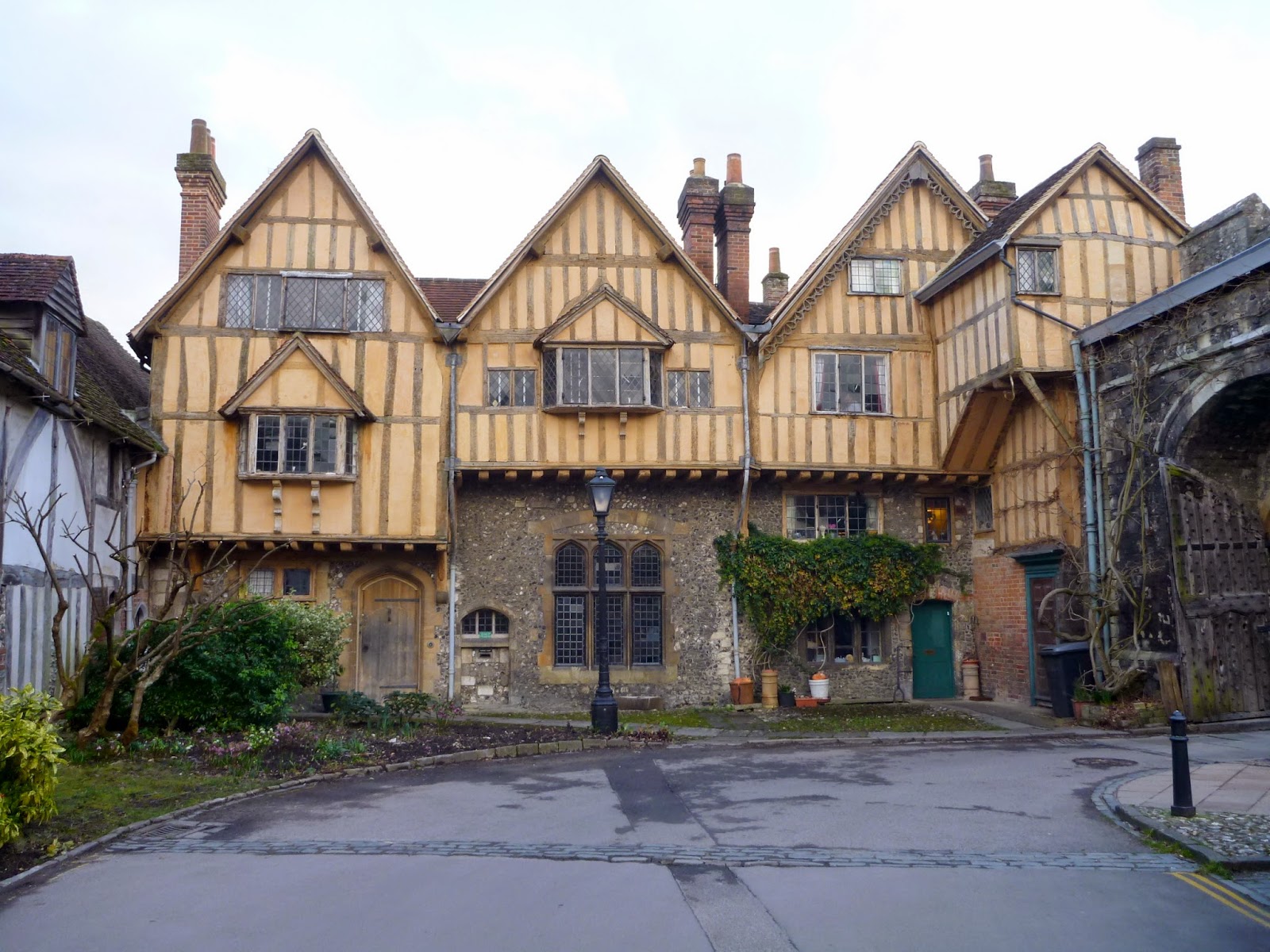
including Cheney Court an Elizabethan timber-framed building which once served as the courthouse.


Next to it, is this long timber-framed building which dates from 1479


and was once the priory's stable block.