Showing posts with label religious art. Show all posts

Saturday, 29 August 2026

Museo de las Bellas Artes - the exhibits


Museo de las Bellas Artes, Seville.

This is a selection of the paintings in the permanent collection of this museum which is considered one of the finest of Spain. There will also be four posts on individual artists.

Most of the art in the museum's collection is religious. We found it a bit too much. But there is an explanation for this. 

The conquest of Seville by Ferdinand III the Saint in 1248 gave rise to the gradual transformation of the Muslim city. While Islamic architectural features and artistic techniques continued to exist, the new local culture began to incorporate Christian art. This took the form of mainly religious figurative representations on paintings and sculptures, although it also extended to wall paintings and illuminated manuscripts.

The arrival of artists from the north sowed the seeds for a local school of painting that grew ever stronger as the 15th century progressed, with both Flemish and Italian aesthetics permeating the art of the Iberian Peninsula. The presence in Seville of the Castilian monarchs' court fostered the city's cultural and artistic development. Some of the most important texts of the reign of Alfonso X were composed in Seville. This of course, also explains the large number of churches in the city.


Pedro Nunez de Villavicencio, El Vendedor de Bebidas, 1694


Francisco Polanco,  Santiago el Menor, 1640


Francisco Polanco, Santiago el Mayor, 1640


Mattia Preti, Cristo Resucitado en el Genaculo, 1675


Jan Brueghel, the Younger, El Paraiso Terrenal, 1620

Jan Brueghel the Elder made around 100 paintings of paradise-like landscapes, some with and others without a religious theme. Brueghel the Younger also made a series of paintings on this theme, sometimes borrowing elements from his father.

The museum has two paintings by the Younger on this theme.


Jan Brueghel the Younger, El Paraiso Terrenal, 1620


looking closer


Bartolome Bermejo, San Juan Bautista, 1490


Francisco Pacheco,  San Pedro Nolasco embarca para redimir cautivos, 1605


Francisco Pacheco, Retrato de dama y caballero orantes, 1623


Francisco Pacheco, Retrato de dama y caballero orantes, 1623


Alonso Cano, Las Animas del Purgatorio, 1626


Juan de Valdes Leal, Finis Gloriae Mundi, 1671-72, (oil on canvas)


A weak light offers a glimpse of the interior of a funerary crypt where mortal remains repose in the death chamber. In the foreground, the raw sight of two decomposing corpses - a bishop and a knight reveal the fragility of life and implacable effects of death.


In the Field above, Christ's wounded hand weighs good deeds and vices practised in life. The vices are symbolised in the left saucer of the balance by different animals, while on the right the good deeds are represented by instruments of penitence and fasting, prayer books and a rosary, crowned by the love of Christ: a heart with the anagram JHS. The inscriptions NI MAS (No More) and NI MENOS (No Less) are a solemn warning that virtue and love must prevail over vices in a person's life.


Juan de Valdes Leal, In the Blink of an Eye, 1671-72, (oil on canvas)

This work is a reminder that death comes inevitably to everyone, in the blink of an eye, stripping away the riches and ephemeral pleasures accumulated in this world. The reflection is an invitation to prepare one's soul for eternal life. 

Death is depicted as a skeleton whose piercing gaze interrogates the viewer. Poised to fullfil his mission, the skeleton holds a coffin, shroud and scythe. In a theatrical gesture he extinguishes the flame of life while standing on a globe, an illusion to his victory over earthly life. At this feet, like a vanitas, a collection of valuable objects symbolises the fleeting nature of life and the irrelevance of worldly triumphs - power (whether earthly or spiritual), wealth, wisdom and accolades - in the face of eternity.


Thursday, 17 April 2025

The allure of the bizarre


The Allure of the Bizarre at the National Gallery, Athens.

Works by artists who embrace, explore and depict the weird, the hybrid, the unclassifiable, and the grotesque. 

The exhibigtion runs alongside an exhibition of Goya’s Los Caprichos from 1799, it spotlights contemporary interpretations of the fantastical or grotesque that the Spanish Old Master also explored. 


Celia Daskopoulou, Rivals, 1974, (oil on canvas)


Yannis Gaitis, The World's Strange Things I, 1963, (oil on panel, (door))


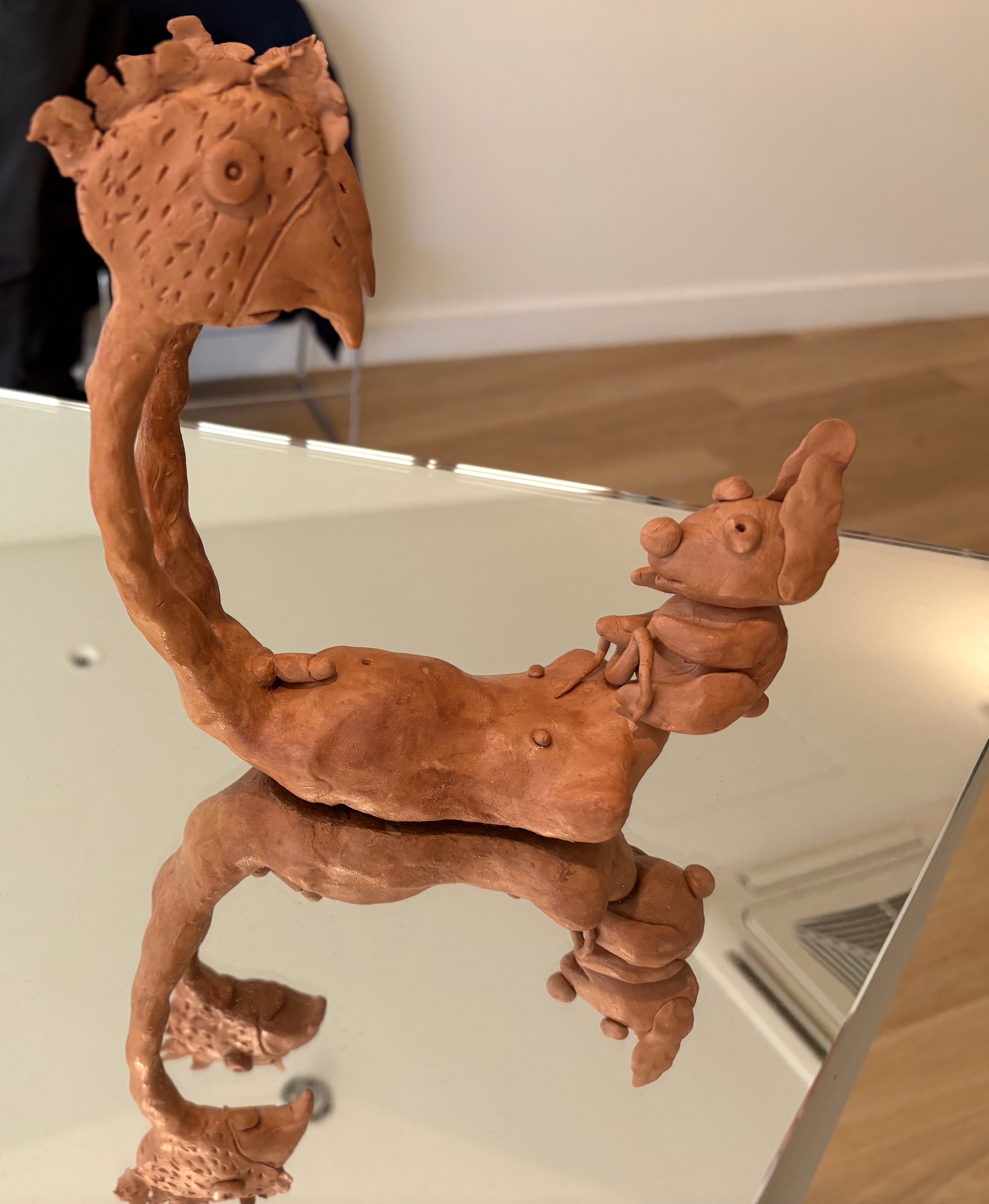
Malvina Panagiotidi, The Fools I-XII, 2018, (air-dry-clay)


Dionisis Kavallieratos, Equestrian Ballerino, 2020, (colour pencil on paper)


Dionisis Kavallieratos, Vagabonds of the Western World (blue), 2020, (colour pencil on paper)


Dionisis Kavallieratos, Zuchinelo, 2019, (colour pencil on paper)


Dionisis Kavallieratos, Mr Scary, 2020, (colour pencil on paper)


Tasos Mantzavinos, For my Power is Made Perfect in Weakness, 2013, (oil on canvas)


And then, this: a blank wall, no pictures but hooks and labels. A new form of artwork? No.

I asked one of the assistants and was told that the artworks were vandalised by, yes, an MP. Nikolaos Papadopoulos, MP of the far right Party, Niki (Victory). The religious fundamentalist, right-wing politician stormed into the National Gallery on March 10th, and forcibly removed and threw to the ground, four paintings by Christoforos Katsadiotis, while shouting 'they insult our religion'.

The MP was initially detailed at the museum and then by the police before he was released citing political immunity. According to reports in the Greek media, the authorities have confirmed that he will face charges of aggravated vandalism.

The gallery was forced to close on Monday but re-opened the next day. The gallery decided that the paintings should remain on the floor where they were thrown, but they were later removed so we were not able to see them. Following protests I now understand that the paintings have been reinstated, which is the right decision of course, as freedom of artistic expression has to be preserved and violent vandalism and censorship have to be opposed.

After seeing the exhibition I went to the gallery bookshop found the book on the exhibition and photographed the paintings which you can see below.


Christophoros Katsadiotis, Icon No. 1, 2021, (etching, stitching with thread, metal)


Christophoros Katsadiotis, Icon No. 2, 2021


Virgin Mary and Christ, 2021


Christophoros Katsadiotis, St Christopher, 2020, (etching, monotype - colour)


Katsadiotis has explained how he is intrigued by the ambiguity and implicitly menacing nature of religion, represented by saints 'who threaten that, if we're not on their side, we will face all manner of trials and tribulations'. He added that religion 'is the most kitsch element of our folk history - full of miracles, tragedies and curses, it is our modern mythology'.


Wednesday, 3 June 2015

Stockholm Cathedral


Built on the highest point of Stadsholmen island, Svenska Kyrkan, Stockholm Cathedral, dates back to the middle of the 13th century. Major conversions and extensions took place in the 14th and 15th centuries, but there are still some parts that date back to 1306.


The exterior was rebuilt on 1736-42 in Italian Baroque style to be a more appropriate complement to the Royal Palace, which had also been recently rebuilt.


The back of the cathedral.


It's a very impressive building.


The Silver Altar is made of ebony and silver.


looking closer


The sculptural ensemble of St George and the Dragon is carved out of oak with details made of materials such as elk antlers and horsehair.


There are two royal pews used exclusively by members of the royal family when attending official ceremonies in the cathedral. The pews were designed by Nicodemus Tessin the Younger in 1684 and were carved out of wood.


The Pulpit dates back to 1700 and is as sumptuous and extravagant as the royal pews.


The organ was built in 1960 and has 53 stops.


The seven-branched candlestick is 3.7 metres high, made out of bronze. It has stood in the Cathedral for more than 600 years.


I could not find any information on this modernist religious painting.


The Crucifixion was created by David Klocker von Ehrenstahl in 1697.


Detail of the ceiling


The Parhelion painting depicts a light phenomenon that occurred over Stockholm on 20 April 1535. Six sparkling luminous rings of light, parhelia (sun dogs, or mock suns) were observed.  They were interpreted to be a revelation of the impending collapse of worldly power, and people flocked to the churches.


A clearer depiction of the phenomenon.


The candle globe has been in the cathedral since 1972 and is the work of Torolf Enstrom.


I could not get any information about this stunning stained glass window.