Tuesday, 12 October 2021

Autumn swimming


Our beach has closed for the winter. It all happened overnight, unlike other years when the preparations for the winter would take weeks, where every few days a few more umbrellas would be taken down and we would get psychologically prepared for the end of the summer.


All that's left now is the net, a few buoys and a few pedaloes which will disappear in the next few days.

I think storm Athena has quite a lot to do with this sudden dismantling of the beach. Strong winds and pouring rain kept most people indoors on Friday, but even though the storm is meant to go on for almost a week, Saturday was sunny, warm even if a bit cloudy, so we set out for a swim. (Incidentally, in the evening we went to Edem bar, sat by the sea, marveling at the steel grey of both sea and sky, and then moved next door to the restaurant. Just as our food arrived, it started pouring again: the waiters were quietly efficient in moving us under large umbrellas where we were able to finish our meal and enjoyed sitting there, listening to the rain crashing down on the roof of the umbrella. It was a good evening).


So, we walked down the path 


that leads to the free beach, which was renamed Cape Sol this year.


A lovely bay which is relatively sheltered and perfect for autumn swimming


A rock formation at one end of this bay, while at the other end you can see the net that surrounds the pay beach.


It's a sandy beach which unfortunately is not as well looked after as the pay beach - the fag ends on the sand, irritate, but we do not tend to linger as we do in the summer, we just have a long swim and go. 

I love this single sun ray captured by the camera.


This is what one can see when standing by the rocks


I like the new changing huts which are reminiscent of English beach huts. As you can see there are quite a few people who are still swimming, despite the cooler weather.


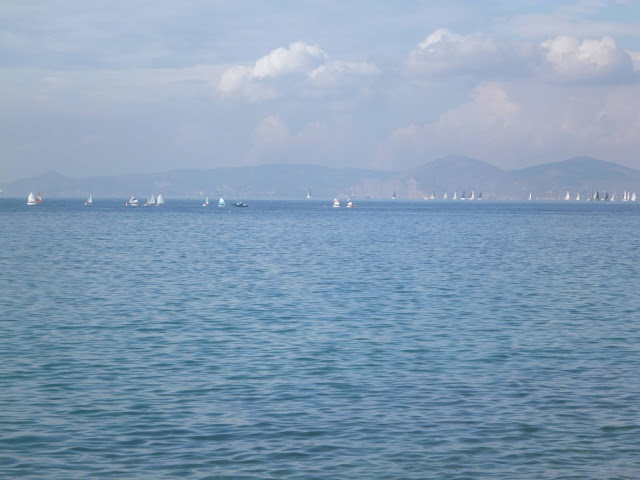
While standing on the rocks, in the other direction, I could see the sailing boats in the horizon. It's the same every weekend, where loads of people go sailing, some of them learners.


We had one of the best swims of the year. We started from here


swam around the corner


swam alongside these rocks, 


parallel to the Promenade where we walk on our way to the Marina


more boats in the horizon


came upon a few more swimmers on the way


past the tiny, tiny sandy beach in the middle of the mass of rocks that define this part of the coast


 swam up to the wall that surrounds the marina, and then swan back. It took us over an hour. 


The next day was very different. The sky was dark grey as was the sea. We could hear the thunder rumbling continuously as we walked to the beach, and it continued doing so the whole time we were swimming. We decided to swim across the bay and back this time, as the weather looked very ominous 


but it did not deter the people who were swimming. We were half way back from the end of the bay when the lightning started. It was time to get out of the water, and we did so as fast as we could.


The boats looked very pretty against the grey.


It started raining as we were getting changed, 


but that did not deter the winter swimmers outside their hut, who were dancing to the sound of loud music. 


Monday, 11 October 2021

Getting ready for Christmas?


Absolutely not! 

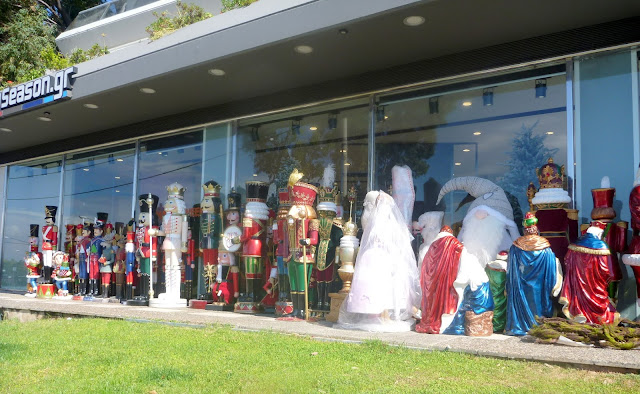
But, this shop, on Poseidonos Avenue, is.


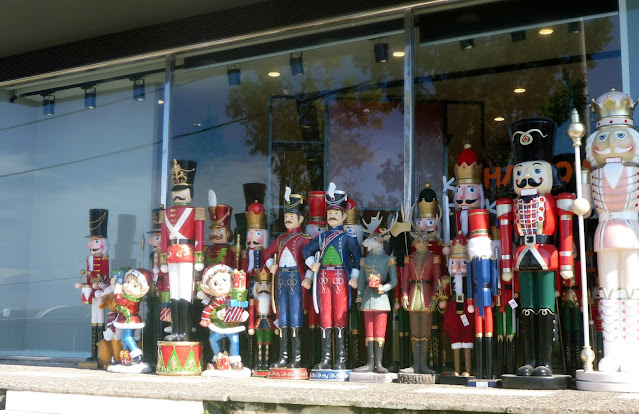
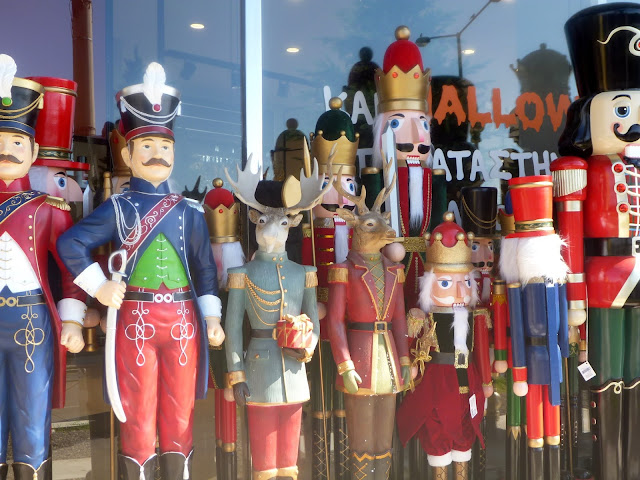
We saw all these figures outside the shop, and we had to cross the road and backtrack to have a look, particularly since we were coming back from swimming and the whole thing seemed utterly surreal.


A bit too early, isn't it? 


We had a look through the windows and the interior was a hub of frantic activity: Christmas trees, unopened boxes, shelves full of baubles, wrapping paper and ribbons, assistants unwrapping everything and placing it all on shelves.

And the nightmare begins....


Saturday, 9 October 2021

Bougainvillea


They are everywhere in the summer and autumn, climbing over fences, houses and other plants. Their vibrant colour is a joy.


The flower of the plant is small and generally white, but each cluster of three flowers is surrounded by three or six bracts with bright colours, including pink, magenta, purple, red orange, white or yellow.


The plant is sometimes called 'paper flower' because its bracts are thin and papery. Those bracts, because of their nature, persist on the plant for a very long time.


Wednesday, 6 October 2021

Fayum


Fayum portrait at the Benaki Museum, (painted on linen, with pigments mixed with wax in the encaustic technique).

Fayum, or mummy portraits, are a type of naturalistic painted portrait on wooden boards, attached to upper class mummies from Roman Egypt. They belong to the tradition of panel painting, one of the most highly regarded forms of art in the Classical world. The Fayum portraits are the only large body of art from that tradition to have survived. Due to the hot dry Egyptian climate, the paintings are frequently very well preserved, often retaining their brilliant colours seemingly unfaded by time.

The portraits covered the faces of bodies that were mummified for burial. They were mounted into the bands of cloth that were used to wrap the bodies. The majority were found in the necropolis of Faiyum.

They usually depict a single person, showing the head, facing and looking toward the viewer, from an angle that is usually slightly turned from full face.

The majority were painted on boards or panels, made from different imported hardwoods. The wood was cut into thin rectangular panels and made smooth. The finished panels were set into layers of wrapping that enclosed the body and were surrounded by bands of cloth, giving the effect of a window-like opening through which the face of the deceased could be seen. Two painting techniques were employed: encaustic (wax) painting and animal glue tempera. The encaustic images are striking because of the contrast between the vivid and rich colours, and comparatively large brush-strokes, producing an impressionistic effect. The tempera paintings on the other hand, have a finer gradation of tones and chalkier colours, giving a more restrained appearance. 

The Fayum portraits reveal a wide range of painterly expertise and skill in presenting a lifelike appearance. The naturalism of the portraits is often revealed in knowledge of anatomic structure and in skilled modelling of the form by the use of light and shade, which gives an appearance of three-dimensionality to most of the figures. The graded flesh tones are enhanced with shadows and highlights indicative of directional lighting.


Sunday, 3 October 2021

Christos Bokoros - The Feast

Quiet here: relics
Of the saints sleep;
Quite quiet: do not disturb
The sacred rest
             of the dead.

(Andreas Kalvos)


Christos Bokoros - The Feast, at the Benaki Museum

This year marks 200 years after the Greek uprising of 1821 against the Turkish occupation which lasted for 400 years, and which resulted in the emergence of the new Greek State. Feast is a celebration of this anniversary. 

Feast is organised in four parts:
  • The Blue and White: its aftermath
  • History: its light and its darkness
  • The Heroes, illustrious and unknown: their shadow, their blood
  • Glory Alone: the top of a long desert table, bearing laurels; below, a lamb standing staring at us.
The works were specially made on the occasion of the commemoration of the 200 years from the Greek revolution. They are painted on fabrics and wood. They constitute an 'overflowing of the soul' of the painter, his private tribute to the 'common and substantial'. To those 'shadows of substance' which define him.

Do these shadows also define us? What does the Hero and his/her Virtue mean today? What is our measure for measuring our lives? Against what shadows are we measuring ourselves? Painting thrives in silence. It speaks, reflected on the unprejudiced gaze of the viewer.

Born in 1956, Bokoros studied law. Following his graduation and a brief period of indecision, he entered the School of Fine Arts in Athens and held his first exhibition in the 1980s.  During the 1990s, he sought to portray shared memory and the Temptations of the Invisible, Light and Dark.

In 2004, with The Impenetrable Forest he addressed the disputed legacy of the WWII Greek Resistance and the Civil War that ensued. In 2013 at the Benaki Museum he presented The Bare Essentials, a call for a modest prosperity and the rediscovery of measure in our everyday life, followed in 2016 by Glimpses of the Obscure which you can see  here and here

Feast was a complex exhibition to navigate and follow, I hope I have done it justice in this post, as, like all of Bokoros' work it was complex, thought-provoking and (I can't think of another word) mind-blowing.


The Blue and the White Flag: its aftermath


A huge Greek flag dominates one wall next to the entrance to the exhibition.


Blue and White Flag, 2020-21, (coloured fabric and glue on old wooden panels from mountain bridges)


History: its light and its darkness

An anteroom, completely dark, the four paintings illuminated:


History: Weaving Light, 2020-21, (pigments with glue, oil paints, weaving comb, linen and wood on plywood)


looking  closer at the weaving comb at the base of the painting


History: Weaving Light, 2020-21, (pigments with glue, oil paints, weaving comb, linen and wood on plywood)


Talisman of the Unseen: the Dark, 2020-2021,  (pigments and oil paints on carved wood)


Talisman of the Unseen: the Light, 2020-2021, (gold polished on carved wood)


Heroes, Illustrious and Unknown: their shadow, their blood

Another small room, totally dark, the paintings illuminated:

an angelic portrait of Solomos,
a demonic, dark one of Karaiskakis
and a sorrowful Glory, dressed in black
an invisible gathering of unsung heroes
at a long table, set, stained,
where, instead of treats, drinks and food,
memorial offerings lie,
marks of time, desolation
and at its head a lamb
to stare us in the eye

(Christos Bokoros)


Solomos 1, 2020-2021,  (pigments with glue and oil paints on old wood)

(note: Dionysios Solomos, 1798-1857, was a Greek poet, best known for writing the Hymn to Liberty, which was set to music and became the Greek and Cypriot national anthem in 1865 and 1966 respectively. He was the central figure of the Heptanese School of poetry and is considered the national poet of Greece - not only because he wrote the national anthem, but also because he contributed to the preservation of earlier poetic tradition and highlighted its usefulness to modern literature).


Solomos 2, 2020-2021, (pigments with glue, oil paints, fabric, old wood and gold embroidery on plywood)


Solomos 3, 2020-2021(pigments with glue, oil paints, fabric, old wood and gold embroidery on plywood)


Solomos 4, 2020-2021(pigments with glue, oil paints, fabric, old wood and gold embroidery on plywood)


Solomos 4, 2020-2021
(pigments with glue, oil paints, fabric, old wood and gold embroidery on plywood)


Solomos 4, 2020-2021(pigments with glue, oil paints, fabric, old wood and gold embroidery on plywood)


Karaiskakis I, (pigments with glue and oil paints on old wood).

(note: Georgios Karaiskakis was a Greek military commander and leader of the Greek War of Independence. He helped lift the second siege of Missolonghi in 1823. His most famous victory was at the battle of Arachova. He was killed in action in 1827). 


Karaiskakis 2, 2020-2021, (pigments with glue, oil paints, fabric and old wood on plywood)


Karaiskakis 3, 2020-2021, (pigments with glue, oil paints, fabric and old wood on plywood)


Karaiskakis 4, 2020-2021, (pigments with glue, oil paints, fabric and old wood on plywood)


Karaiskakis 5, 2020-2021, (pigments with glue, charcoal, fabric and old wood on plywood)


Glory Alone: The top of a long table, bearing laurels; below, a lamb standing, staring at us.


The main exhibition room, dark, paintings illuminated.


Glory Alone, 2020-2021, (oil paints and old fabric on plywood)


Table 1, (laurel leaves, linen and cotton fabric, stained with tea on blockboard)

Note: Eleutheria i Thanatos, (Freedom or Death) was the rallying cry of the Greek Revolution.


Table 2, (laurel leaves, linen and cotton fabric, stained with tea on blockboard)


Table 3, (laurel leaves, linen and cotton fabric, stained with tea on blockboard)


Table 6, (laurel leaves, linen and cotton fabric, stained with tea on blockboard)


Table 13, (laurel leaves, linen and cotton fabric, stained with tea on blockboard)


Table 17, (laurel leaves, linen and cotton fabric, stained with tea on blockboard)


Table 20, (laurel leaves, linen and cotton fabric, stained with tea on blockboard)


Table 28, (laurel leaves, linen and cotton fabric, stained with tea on blockboard)


looking closer at the embroidery on the sides


Table 29, (laurel leaves, linen and cotton fabric, stained with tea on blockboard)


Friday, 1 October 2021

Recycling


 The recycling shark on the seafront. Cute, or what!