Tuesday, 11 January 2022

Fungi


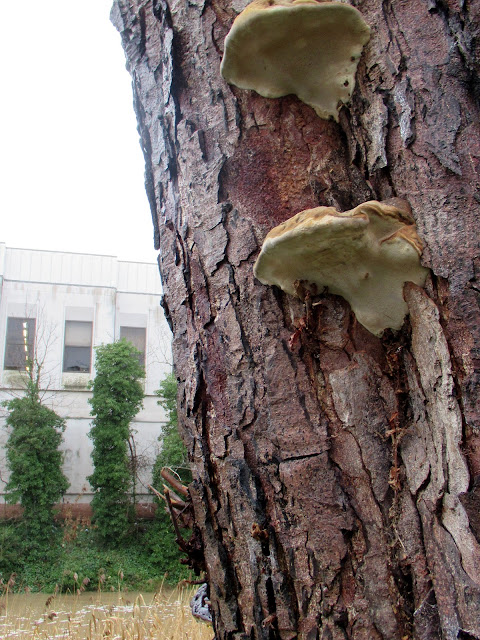
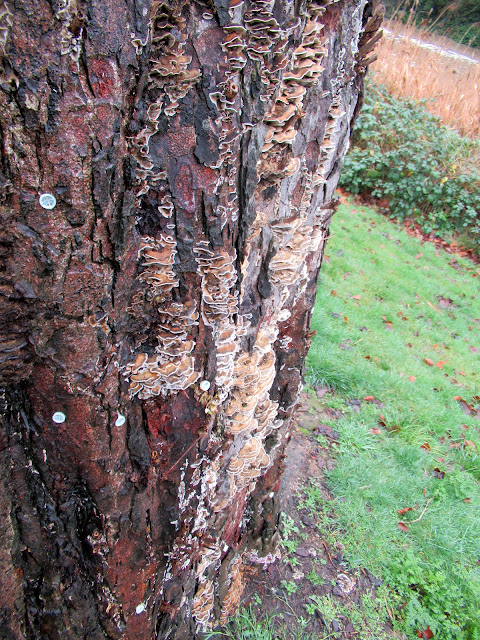
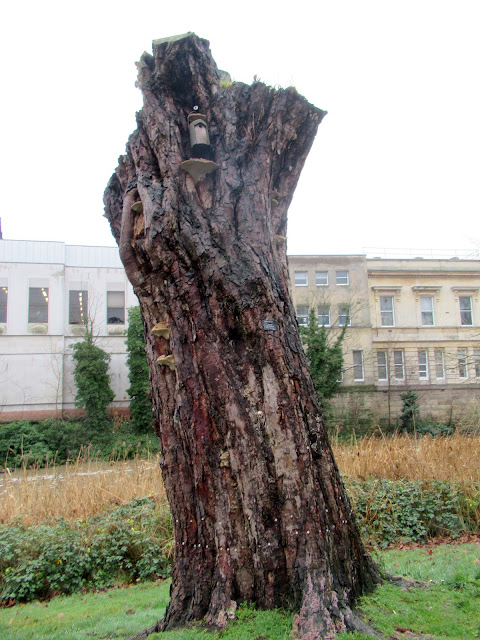
During one of our walks in Jephson Gardens we noticed lots of fungi 


on the trunk of this tree.


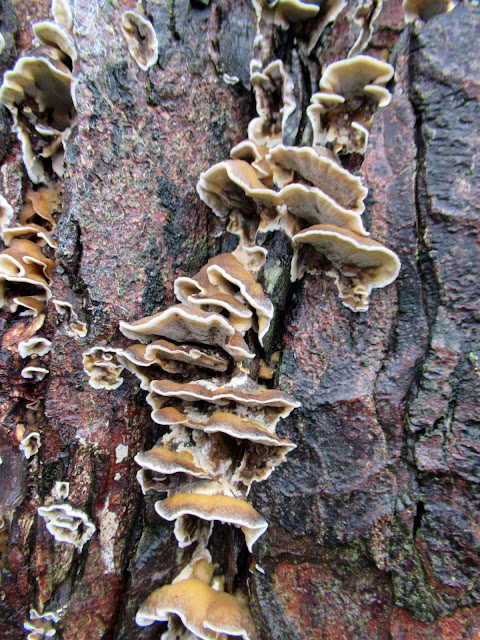
A passerby who also stopped to have a look, told us that it's called chicken of the woods. I looked it up and I think he was right. 

'The chicken of the woods is a bright sulphur-yellow fungus comprising several thick, overlapping brackets. The individual brackets are soft and spongy when young and exude a yellow liquid if squeezed. They are fan-shaped with an undulating margin. The upper surface is velvety and yellow-orange with a zoned margin, while the underside is yellow and covered with spores'.


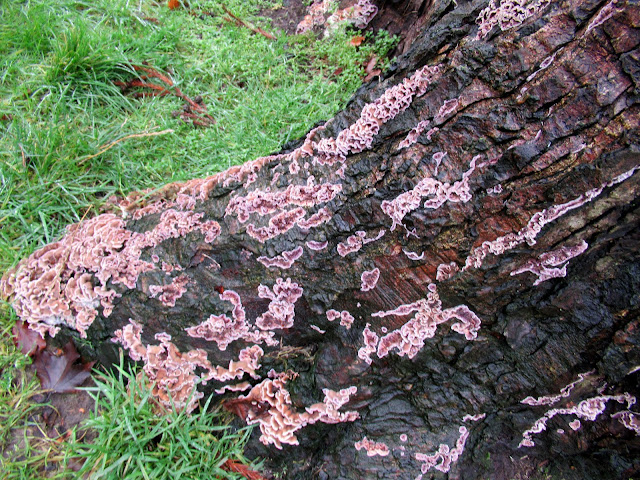
There were some on the exposed roots as well, but those were pink, so I presume a different variety.


There were also some very different ones further up the trunk, thick and fleshy.


Sunday, 9 January 2022

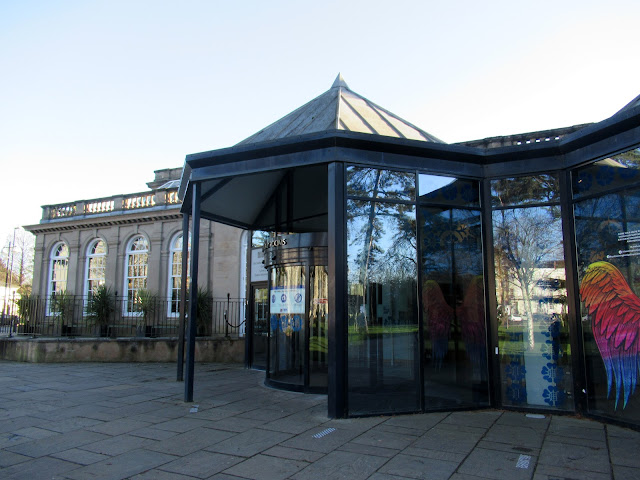
Coventry Biennial: Hyper-Possible at Leamington Art Gallery


Coventry Biannial: Hyper-Possible, at Leamington Art Gallery.

More Hyper-Possible exhibits as part of Coventry Biennial, in Leamington this time. Two of the artists featured in the Coventry exhibition have exhibits in Leamington as well.


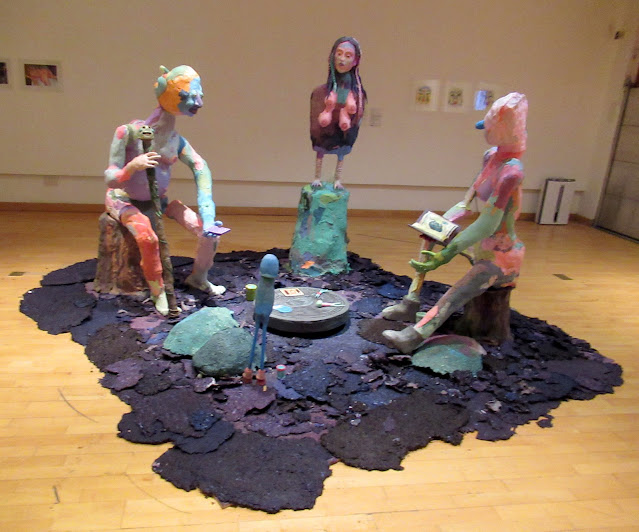
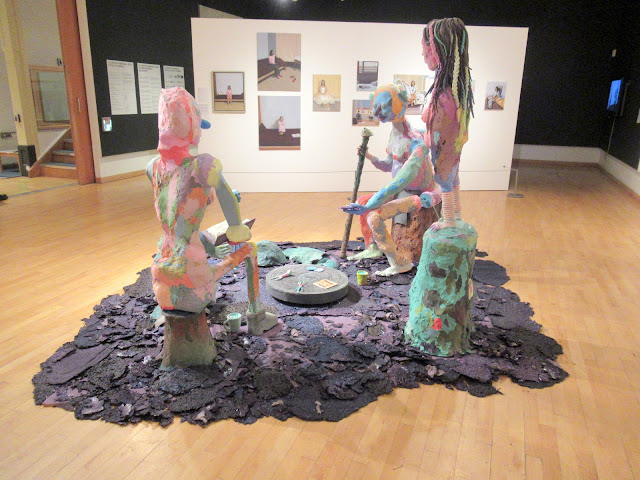
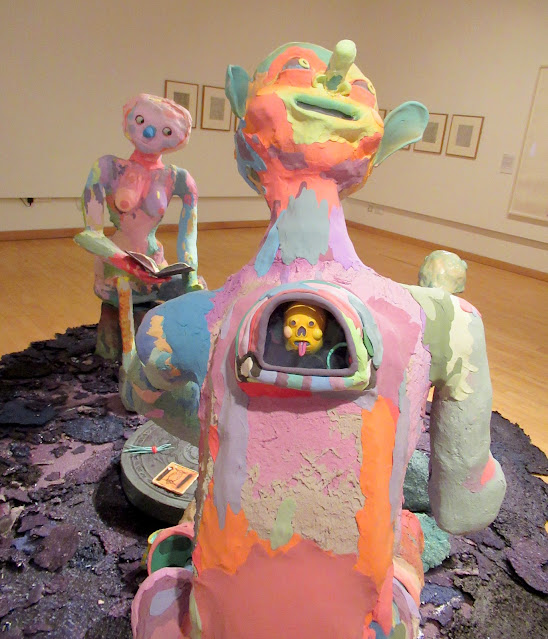
Luke Routledge, Soothsayers, 2021 (animatronic installation)

In Soothsayers, Routledge presents us with a scene in which a group of colourful patchwork sculptures have come together to enact an arcane ritual. Surrounded by talismans and domestic items this installation merges the otherworldly with the everyday.


Claudette Johnson, Standing Figure, 2017, (charcoal, pastel and masking tape on paper)

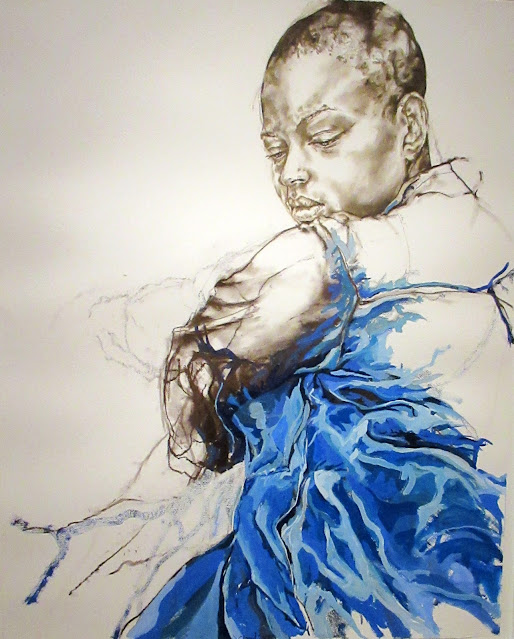
Johnson honours the form figure and strength of black women in her drawings and paintings. The large scale of her work, combined with the sensuality of her style, establishes presence and quiet power. 


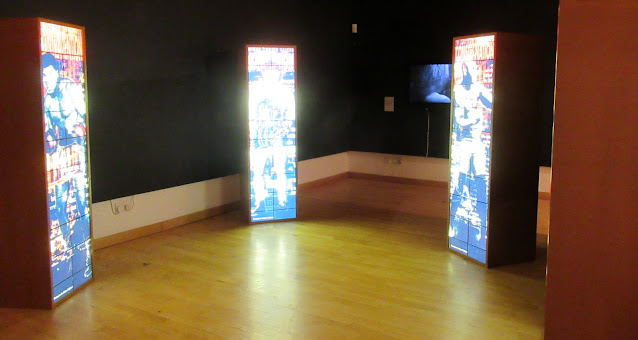
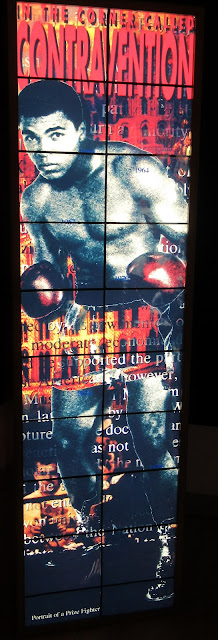
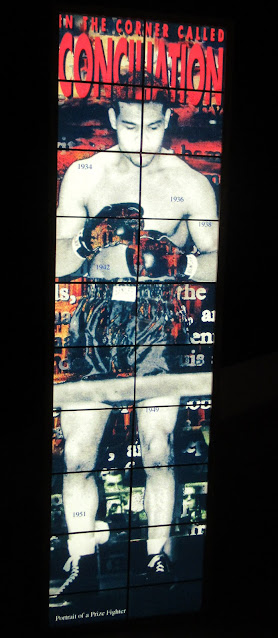
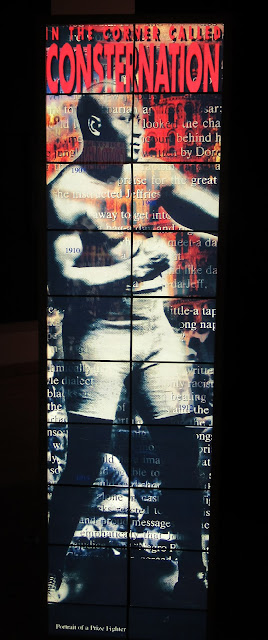
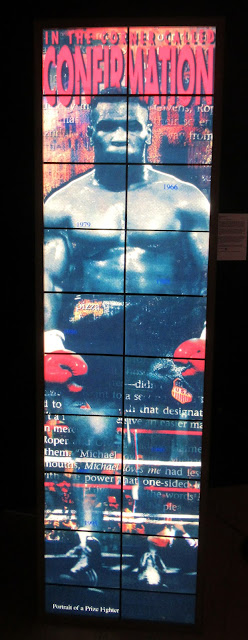
Keith Piper, Four Corners, a Contest of Opposites, 1995, (computer montage prints on transparency film in lightboxes)

This istallation considers the presentation of black male icons who in this work are all boxing champions. 


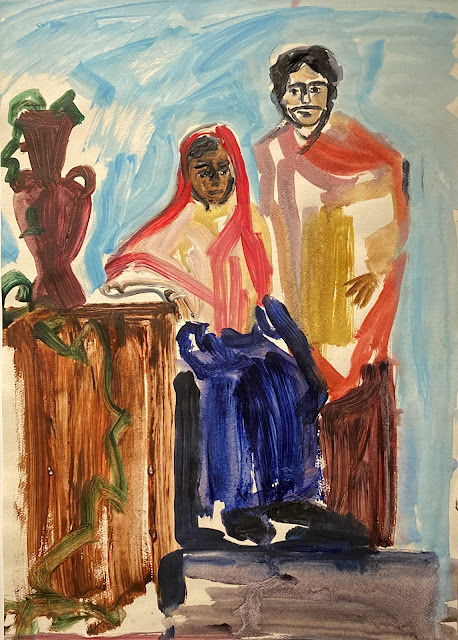
Claudette Johnson, Figure in Blue, 2018, (gouache and pastel on paper)


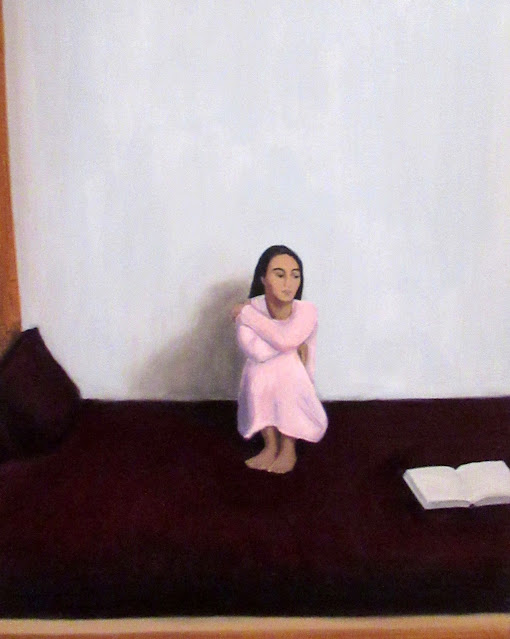
Matthew Krishanu, Girl on a Bed, 2007, (acrylic on canvas)

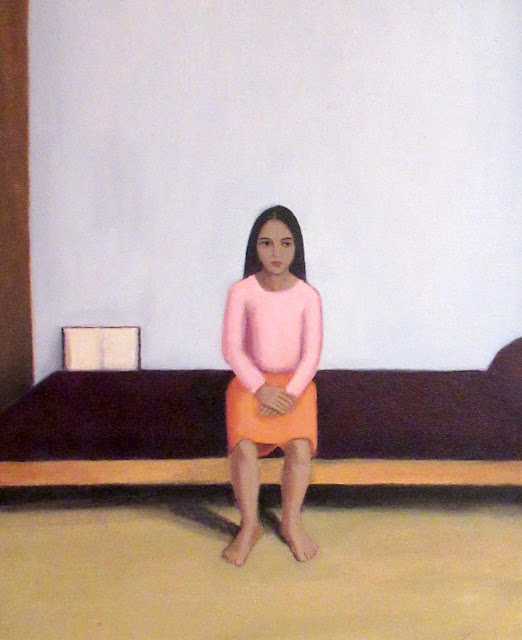
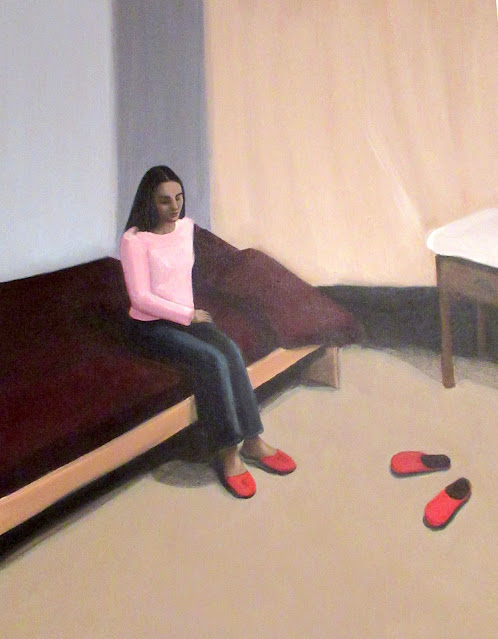
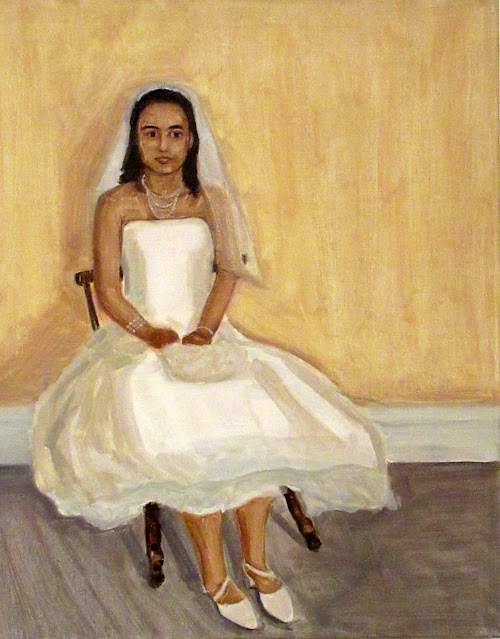
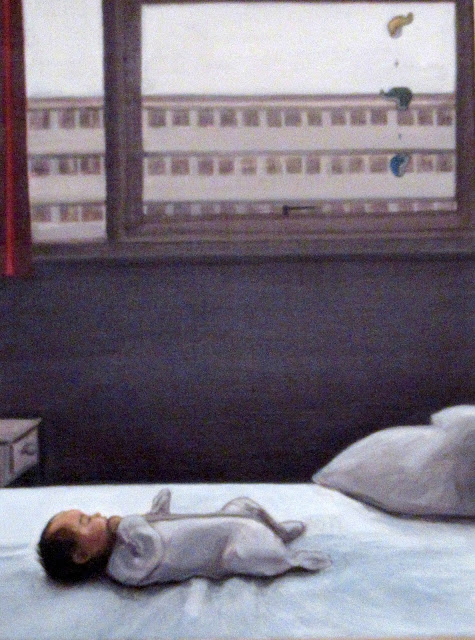
Matthew Krishanu's series In Sickness and In Health features paintings made across a fifteen-year period. These include portraits of his wife, who is currently very unwell and regularly in hospital, alongside their daughter, painted as a small baby (in 2010), who features in the centre of the series.


Matthew Krishanu, Girl with Slippers, 2007-2012, (acrylic on canvas)


Matthew Krishanu, Girl with a Book, 2007, (acrylic on canvas)


Matthew Krishanu, Wedding Dress, 2009, (oil on linen)


Matthew Krishanu, Elephants, 2010, (acrylic on linen)


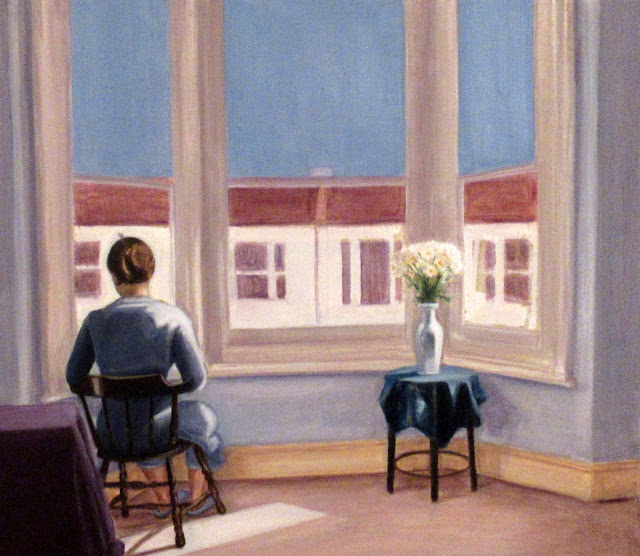
Matthew Krishanu, Room in Brighton, (after Edward Hopper, 2010, (oil on canvas)


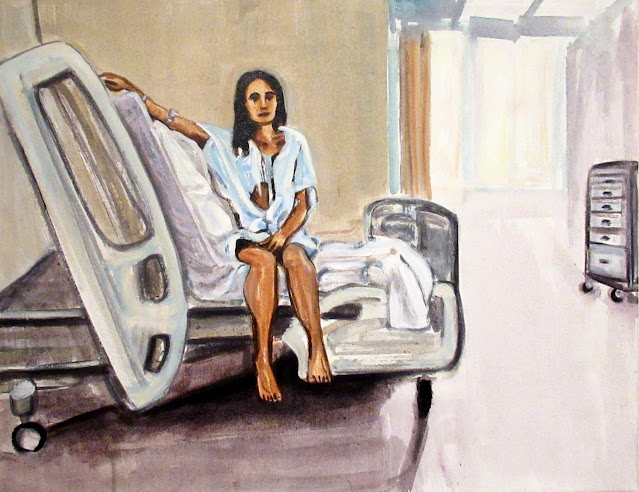
Matthew Krishanu, Hospital Bed (Barts), 2021,


Matthew Krishanu, Hospital Bed (Whipps Cross), 2021, (acrylic on canvas)


Matthew Krishanu, The Convalescent (after Gwen John), 2021, (acrylic on canvas)


Friday, 7 January 2022

Coventry Biennial 2021: Hyper-Possible at the Herbert


Coventry Biennial 2021: Hyper Possible, at the Herbert Art Gallery, Coventry.

This exhibition brings together newly commissioned projects and existing artworks from national collections, creating an opportunity to look back at what has made Coventry and the surrounding area unique, while also reflecting on an increasingly complex global situation.


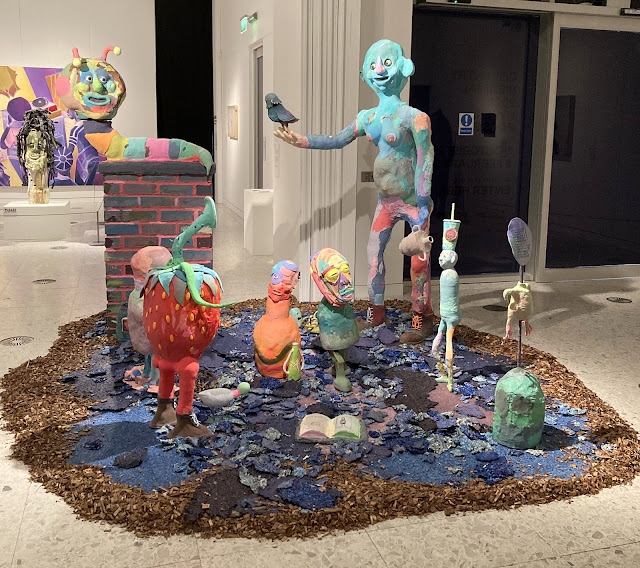
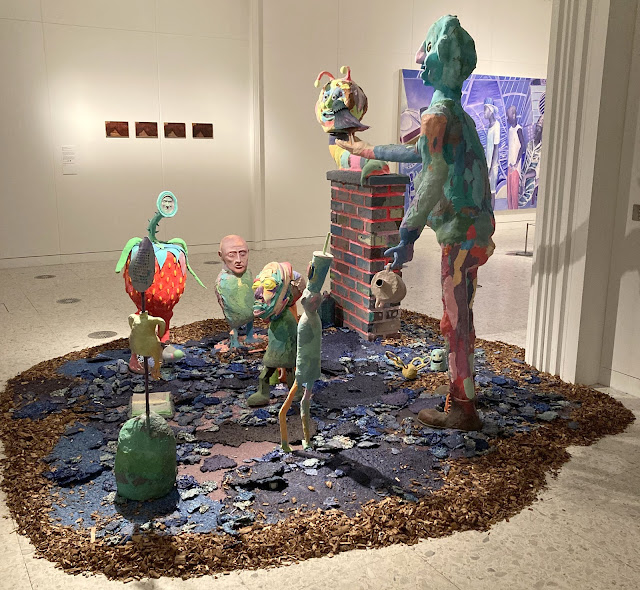
Luke Routledge, The Door in the Wall, 2021, (Animatronic installation)

Figures, creatures and objects populate a speculative and fictional universe. Using the notion of a constructed world or universe as a framework, the sculptures draw upon pseudoscience, philosophy and contemporary culture to stitch together a cast of inhabitants and their surrounding territory and civilisation. 

A portal into the weird depths of Routledge's imagined realm opens onto an assembled party of anthropoorphic, hybrid creatures that frolic upon a clearing, drawing upon traditional sculpture, painting and cartoons in equal measure. A strawberry sprouts legs, a face bursts from their crown as a manu-hued minion carries a milkshake on its head. Nothing unusual here.


Claudette Johnson, Doing Lines 1 (Lockdown) Line Journeys, 2020, (oil pastel on paper)

Johnson made this work during the Covid-19 lockdowns as part of a larger series that she describes as 'warm-up' drawings. She explains that this series is the equivalent of scales practice for a pianist.

She describes the process as 'working freely without too much reflection but at the same time with deep concentration', a method that allows for learning through practice'.


Jeremy Deller, History of the World, 1998, (screenprint) 

(Apologies for the reflection in the image)

Coventry and its surrounding areas have played a key role in the development of Rave and club culture, with the UK's first legal all-night party taking place in the city in October 1990.

Less than a decade later, the music and culture being developed and presented at The Eclipse nightclub had made such a huge impact on British culture that artists, philosopers and academics were beginning to respond to the themes, energy and aesthetics of Rave.

The Cybernetic Culture Research Unit were particularly interested in a style of electronic music called Drum 'n' Bass that was being developed around this time. In the History of the World Jeremy Deller highlights social and political points of connection between Acid House and more traditional Bass Bands.


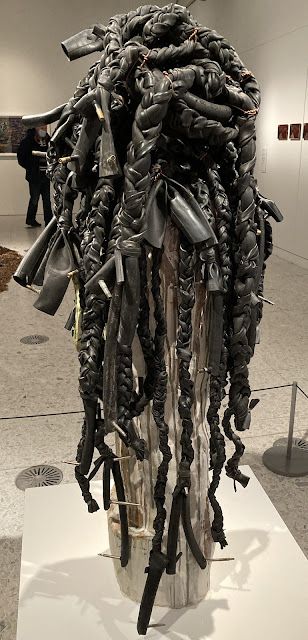
Leilah Babirye, Untitled (series), 2021, (glazed ceramic)

Untitled (Kuchu Series) continues Babirye's exploration of issues relating to identity, sexuality and human rights, all issues that Babirye has dealt with head-on in her life after fleeing Uganda folowing being outed in a local newspaper in 2005. With the support of the African Services Committee and the NYC Anti-Violence Project, she was granted asylum in New York in 2018.

This work uses a wide range of found materials that have been woven, whittled, welded, burned and burnished to think about belonging, family and identity and that aims to address the realities of being gay in the context of Uganda and Africa in general.


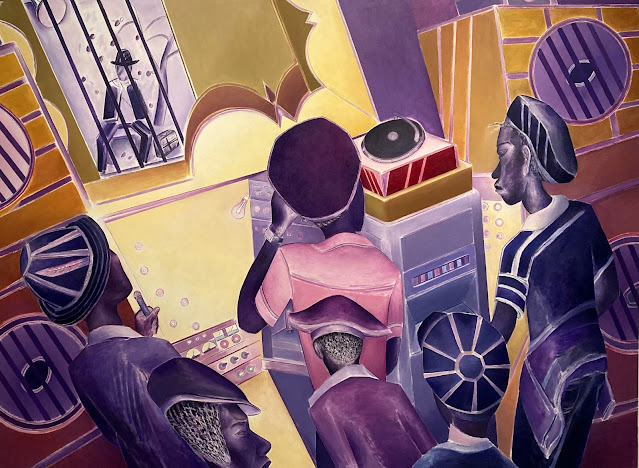
Denzil Forrester, Obeah Man Revival, 2019, (oil on canvas)

Obeah Man Revival is a recent example of British - Grenadian artist Denzil Forrester's expressive depictions of nightclubs. In this work, Forrester focuses on a DJ and four revellers whose distinctive clothing is characteristic of the dub and reggae scene that has inspired his work for over four decades.

Imagined here as an 'Obeah' or West Indian 'witch doctor', the DJ is the artist's eyes is 'the unifier of all the people in the space, giving energy and strength to all at the same time'.


Denzil Forrester, Still Here, 2019, (oil on canvas)

In this work, Forrester focuses on a DJ and his sound system, framed by a pair of Forresters trademark totemic speakers.


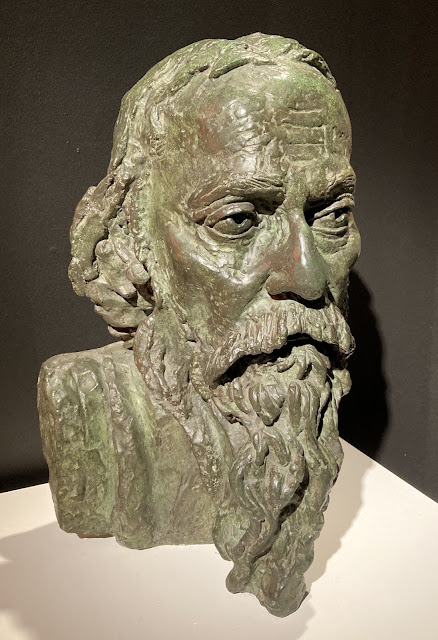
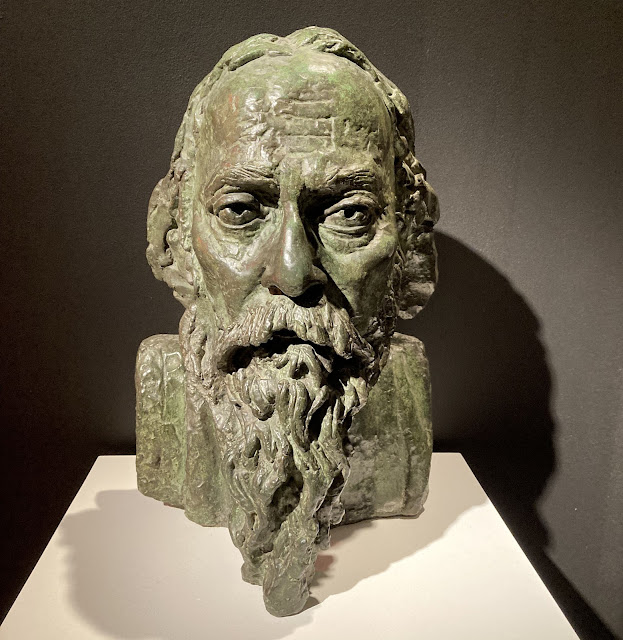
Jacob Epstein, Rabindranath Tagore, 1926, (bronze)

Rabindranath Tagore (1861-1941) was a famous Indian writer, artist, dramatist and social reformer. He was awarded the Nobel prize for literature in 1913.

Epstein worked in contrasting styles influenced by different materials. He modelled in clay in preparation for bronze pieces like this and the statue of St Michael and the Devil at Coventry Cathedral.


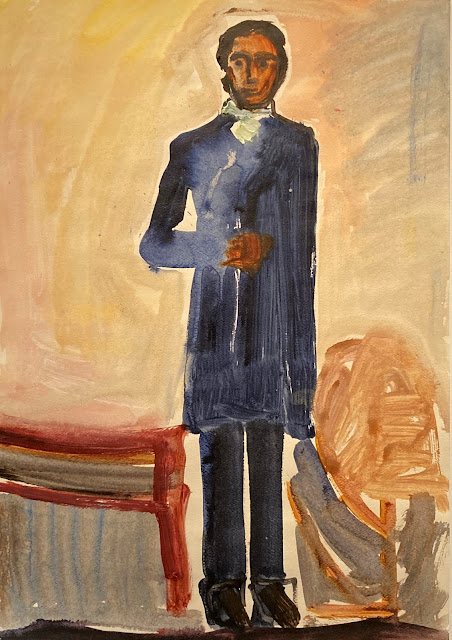
Matthew Krishanu, Young Tagore, 2013, (acrylic on paper)

While Krishanu's works speak to the legacies of the British Empire in a broad sense, there is also a personal connection, Krishanu's experiences growing up and living in Bradford, Birmigham and Dhaka, the capital of Bangladesh, all shaped by childhood memory, resonate strongly with the life of Tagore. 

Much of Krishanu's practice is concerned with the canon of art history, particularly with reference to painting and to museum and gallery collections. His work probes some of the established and largely accepted narratives that exist in relation to racism, colonialism and power.


Matthew Krishanu, Tagore with Mrinalini Devi, 2013, (acrylic on paper)

Tagore with his wife Mrinalini Devi.


John Yeadon, Modern Art, Disco Drawing, 1982, (acrylic and mixed media on paper)

This drawing attempts to capture the energy and highlight the value of gay clubs in the 1980s. Gay clubs were (and continue to be) crucial spaces of education, exchange and expression for the LGBTQ + community.

Yeadon made the work at a time of institutional neglect and homophobia, when the AIDS epidemic was beginning to spread around the globe. 

The experimental use of glitter, fluorescent paint, car spray paint and flashing coloured light bulbs add to the feeling of the viewer being in a disco.
 

Wednesday, 5 January 2022

The recording of Ghost Town by the Specials


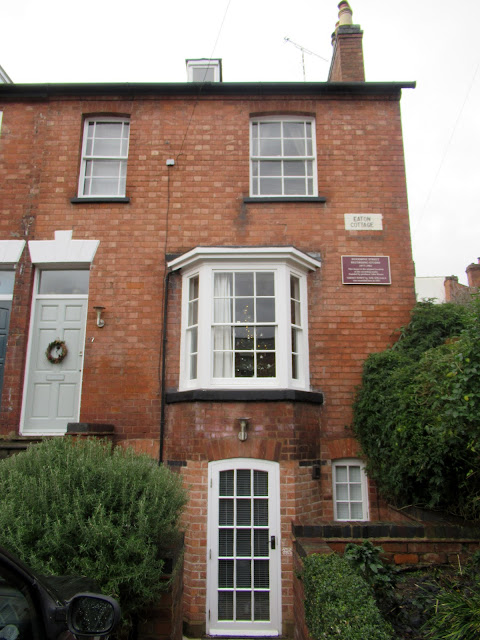
A Special Interest Plaque was unveiled recently in a small Victorian house in Leamington. The Coventry-based two-tone and ska revival band The Specials recorded their UK no. 1 song Ghost Town at 27 Woodbine Street, the original location of the Woodbine Street Recording Studio in 1981.


In 1973, John Rivers bought the house because 'it was the cheapest house in Leamington'. It had all the problems of old houses, but it also had a redeeming feature,  a cold, dark, damp and windowless cellar. Rivers bought an old Sony valve tape recorder and started recording musician friends in the front room of his new house. His growing reputation led to more ambitious recordings with even more musicians. In 1975 he bought a 4-track tape machine to improve the quality of his recordings. The problem was that the front room was too small to cope with the increasing number of musicians and the complexity of John's recordings. He consequently converted the windowless cellar into a recording studio. The new studio was incredibly successful with many new artists recording there, including The Shapes, Swell Maps and Eyeless in Gaza.

Most groups recorded playing live, squashed together in the studio's tiny space. However, this was not possible in the case of the most famous group, The Specials, as it was impossible for all seven members of the group to perform together, so each was recorded separately in the studio. The result was Ghost Town - 'one of the most evocative and provocative singles of all time and a graphic depiction of the inner city-deprivation and urban unrest prevalent throughout the UK in the early 1980s'.

Horace Panter, bass player in The Specials, who attended the unveiling said: 'The Specials recorded one of the most iconic pieces of 20th century pop music in a studio in the basement of a small Victorian house in Leamington. It was not only a snub to the unnecessary extravagance of the music industry, but a homage to the music that influenced us'.

Ghost Town was the Specials' most successful single ever, spending three weeks at No. 1 in July 1981. However, the ten day session in John's studio was the last time that The Specials would record together as they separated later that year.


At this point I would have liked to post the track of Ghost Town, but new blogger does not allow me to do that anymore.  

You can read more about 2 Tone  here


Monday, 3 January 2022

Coventry mural


 A mural at Coventry bus station which epitomises the cultural history of the city in the 1980s.

The late 1970s and most of the 1980s, was a time of economic and social turmoil in Britain, when the country seemed to be in a state of continuous crisis, and felt close to outright collapse: strikes disrupted basic services, filling city streets with mounds of garbage; far right movements marched and clashed with counter-protestors; in towns and cities factories were closing and many were unemployed; by 1982 unemployment had risen to 20%; young people especially felt alienated and pessimistic about their future; racial tensions were high, with racist attacks and anti-immigration demonstrations making the news. 

These conditions formed the backdrop to an incredible rise of productivity in music: 2 Tone emerged with a strong message of anti-racism and inclusivity; punk branched out; reggae became increasingly influential; the Specials, a band of black and white musicians emerged with their distinctive sound of a blend of punk and reggae; Hazel O'Connor became prominent in 1980 as an actress and singer when playing the role of Kate in Breaking Glass; Manjinder Kirk, actress, director, writer was also from Coventry; Cathedral, another band that was based in Coventry.

In the mural, from right to left: Hazel O'Connor, Terry Hall from the Specials, (who then went on to form Fun Boy Three), I am not sure who the third person is, and last, Manjinder Kirk.


Saturday, 1 January 2022

Trees Wearing Jumpers


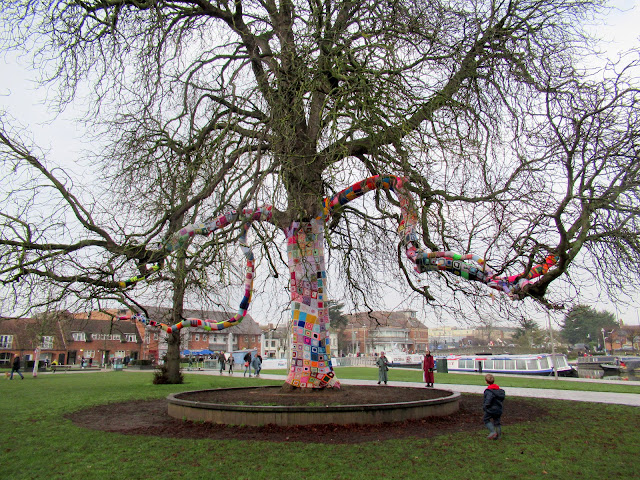
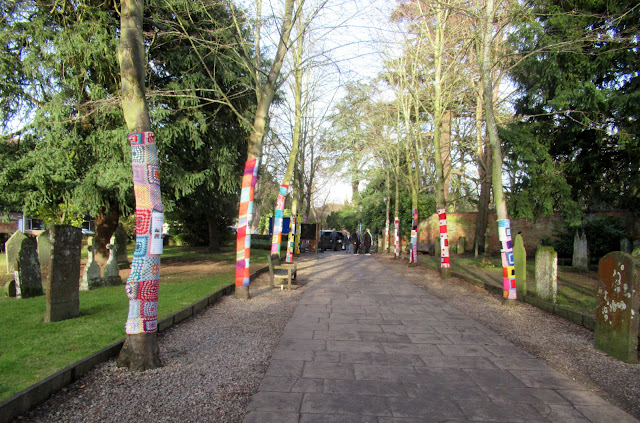
Walking through Stratford-upon-Avon one can see some trees that are brightly decorated with wool. This one is in the square in front of the Shakespeare Theatre near the canal basin.


The kids, of course, love it.


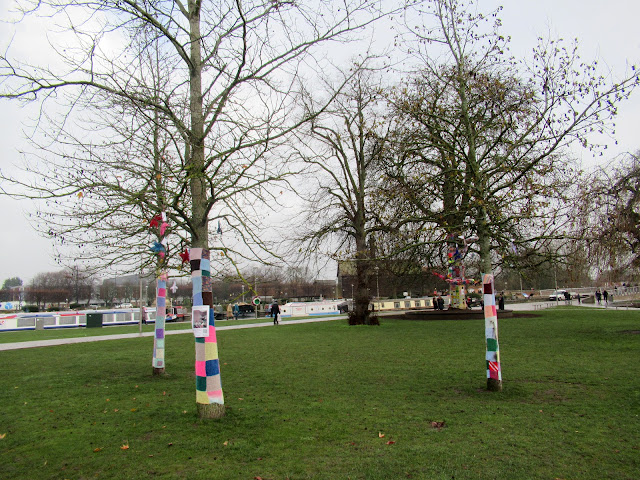
Some more, further along.


There are a lot more by the Holy Trinity Church.


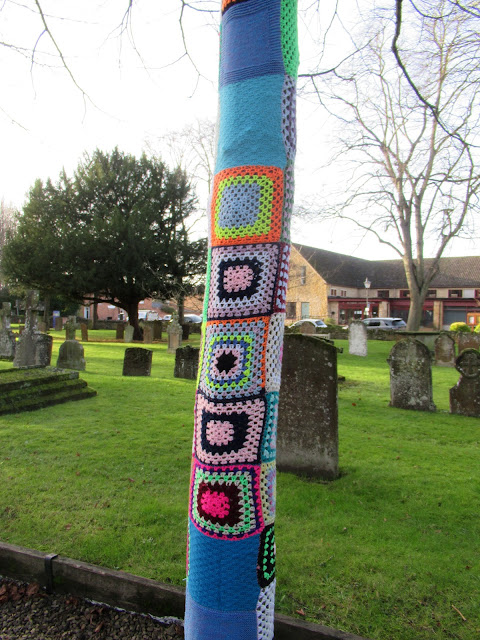
They've been' yarn-bombed' for charity. The project is called The Remembering Tree, created by local Stratford-upon-Avon based charity Goodwill and Growth for Africa UK (or GAGA-UK).


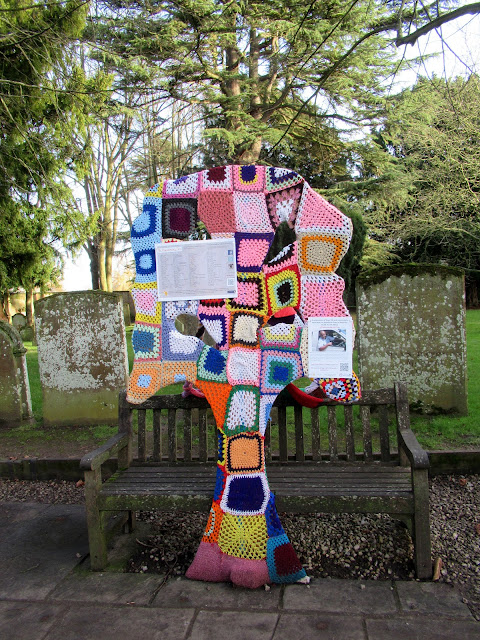
The trees are wrapped in hundreds of knitted or crocheted squares (made from synthetic wool so as not to damage the tree) to raise funds and awareness for their cause. Individuals can buy a square for £5 or a bauble for £25; this money goes to GAGA-UK to help suport their work in Africa, and your square or bauble is dedicated to celebrating or remembering a loved on at Christmas - hence, the name,  Remembering Tree. The dedication is put on the list next to the tree and is also published in the Stratford-upon-Avon Herald newspaper.


Even the noticeboard has been yarn-bombed.


I would like to take this opportunity to wish everyone a Happy New Year. Let's hope that 2022 will be kinder to all of us.